By Susan Chen, ChatGTP & Ethan Lin contributed to the Chinese-English translation
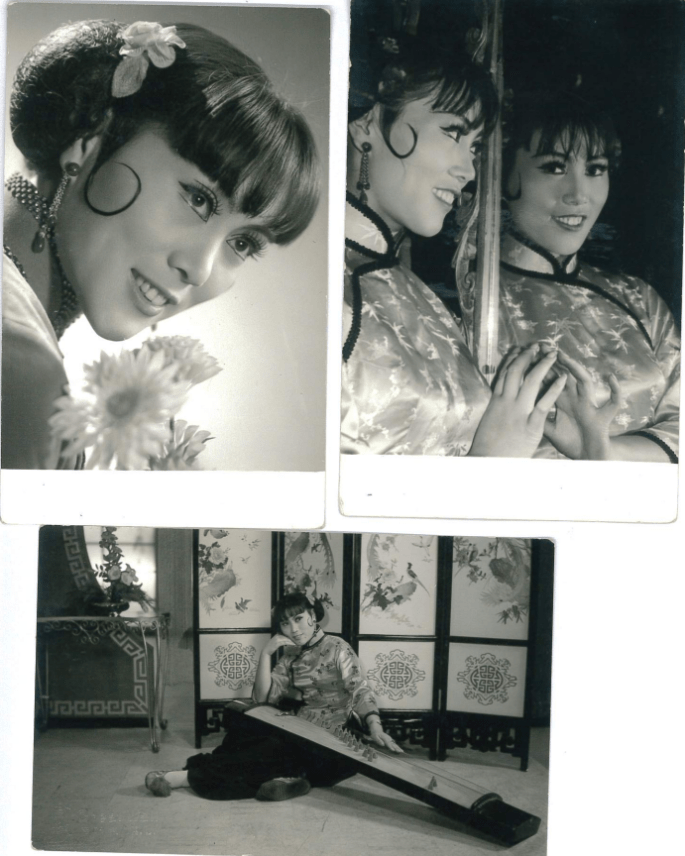
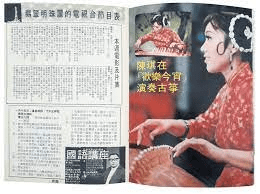
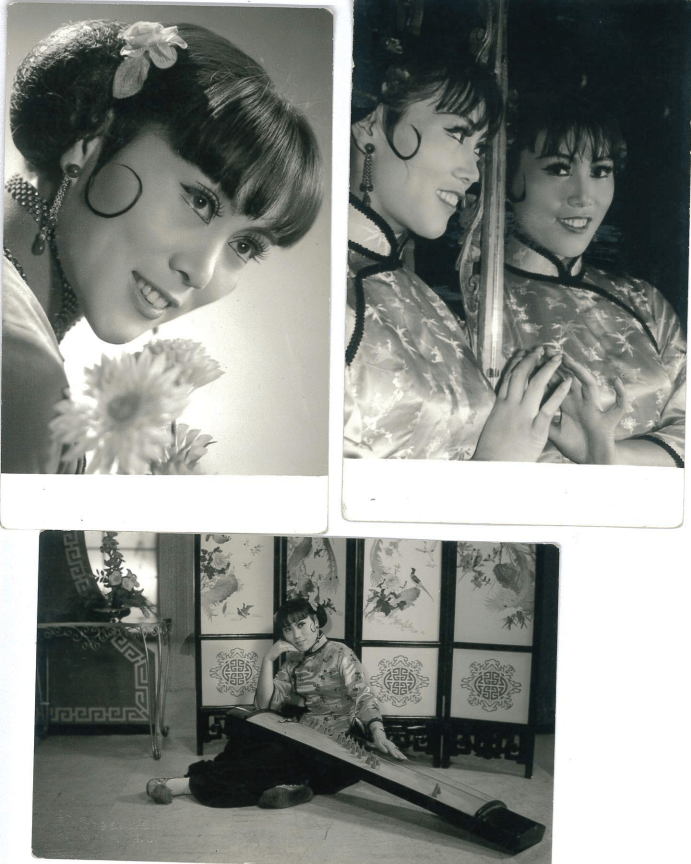
In a radio and television magazine in 1970, there was a striking full-colored picture of an elegant and graceful young woman wearing a qipao, with her hair styled in a bun, playing the guzheng with concentration. The caption read, “Chen Qi performs the guzheng on ‘Joyful Tonight.'”
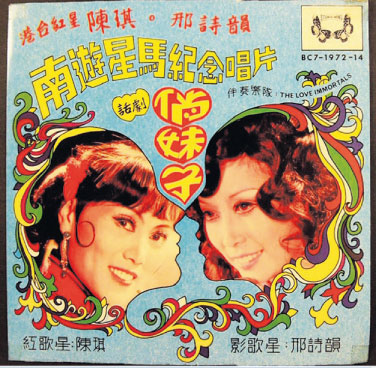
“Joyful Tonight” was once the most popular and long-lasting variety show on Hong Kong television in the 1970s and 1980s. Many top actors from TVB participated in it. When Chen Qi appeared on the stage of “Joyful Tonight,” many viewers and even production staff were curious and asked, “Where did this unknown Chen Qi come from, and how can she play the guzheng and sing so beautifully?”
She Was the Beloved Daughter of a General
“I was born in 1940 into a fairly well-off family. My father was a Nationalist Army officer – a division commander and major general. During the Sino-Japanese War, he staunchly resisted the Japanese and was killed, with his head cut off and displayed on the city wall. He became China’s famous ‘Beheaded General Chen Zhongzhu.’ After his death, the Nationalists promoted him to lieutenant general. I was only one year old at the time.” (Chen Qi, in her autobiography “Journey of the Guzheng”)
General Chen Zhongzhu, a native of Yancheng, Jiangsu, sacrificed himself against the Japanese in 1941 at the age of only 35, leaving behind two daughters and a posthumous son. Chen Qi was the second daughter. Although Chen Qi had no memory of her father, according to her older sister, she was the most precious daughter to General Chen. General Chen loved to hold baby Chen Qi in his arms, praising her for being beautiful and naming her “Qi” Anqi’er, meaning angel in Chinese. After coming home from work every day, General Chen’s first act was to visit Chen Qi in her room.
A Challenging Fate, But Blessings from Above
Her father’s love did not bring happiness to Chen Qi’s life. From the time Chen Qi could remember, she felt like an extra in the family, a punching bag for her family members, and the most useless individual. This upbringing molded her into a timid and fearful individual to the point where she was even afraid to speak and had developed unclear speech. Moreover, after the Chinese Communist Party (CCP) took power, Chen Qi’s family was targeted due to her mother’s background as the wife of a Nationalist Army officer. Her mother was imprisoned, and due to Chen Qi’s “bad class,” she faced discrimination at school and within society. With a strong-willed personality, Chen Qi put all her energy into studying, striving to be a good child in hopes of earning the approval of others. Despite growing up in adversity, her determined personality and innate musical talent led to her future success in the arts.
Music had always been Chen Qi’s passion, and a music teacher recommended her to join the “High School Arts Troupe.” However, due to a mix-up, she was accepted into the singing section, which eventually revealed her talent in singing. Chen Qi learned a lot of musical knowledge which would be useful later in life. Since she frequently participated in the art troupe’s performances, she was fortunate to avoid the difficult times when students of her generation were forced into labor or sent to the countryside during the Cultural Revolution.
During the Cultural Revolution, all traditions and cultures were trampled upon. Sun Zi Xian, a master of the guzheng and one of the disciples of Chen Qi’s master, was a school worker in charge of the grain station during those times. In his spare time, he taught eight of his favorite apprentices for free, and Chen Qi was fortunate to be one of them. Chen Qi had a special fondness for the deep and elegant sound of the guzheng, so she worked diligently at her guzheng playing. Chen Qi even exchanged her valuable gold necklace for her master’s guzheng and inscription. Later, when she moved to Hong Kong, her master’s guzheng was saved from the horrors of the Cultural Revolution and her learning continued in Hong Kong. When Sun learned about these events, he tearfully said to Chen Qi, “Thank you! Thank you!”
Outstanding Academics and the Arts, but No Opportunities
Despite excelling in academics and the arts, Chen Qi, who had graduated from high school, was unable to be accepted into an art school due to her “class background.” Finally, she had the opportunity to enroll in a medical school as a backup. Chen Qi had no interest in traditional Chinese medicine, but she saw it as a path to get into college and hoped to find a job after graduation. However, the Ivory Tower was no longer a haven. The political mess of the Communist society had tainted every corner of China. Despite her outstanding academic achievements, Chen Qi faced discrimination at school due to her “bad class” background. However, what caused Chen Qi to become truly despaired was an incident that happened shortly thereafter.
One of Chen Qi’s former schoolmates came to the medical college to apply for a job, and the head of the personnel department asked to meet her in the dormitory. Chen Qi waited outside. A short while later, the schoolmate came out, her face flushed with anger and her hands trembling, she told Chen Qi, “That jerk wanted me to be his girlfriend in exchange for admitting me to the medical college.” At that time, the female student union leader seemed approachable, so Chen Qi told her about what had happened to her schoolmate.
To her surprise, the next day, the party branch secretary came to find Chen Qi and scolded her harshly, accusing her of spreading rumors and undermining the credibility of the party and its leaders. After this incident, Chen Qi’s days at school became even more difficult. In despair, Chen Qi had to ask a doctor for a certificate of neurasthenia and took a leave of absence from the medical college. Without a college degree, Chen Qi couldn’t find a job and had to work as a substitute teacher. She felt insignificant and useless.
From the time she was aware of her surroundings, Chen Qi had been subjected to political persecution by the Communist Party. This left an indelible scar on her life. More than a decade later, Chen Qi went from the pinnacle of the Hong Kong art scene to washing dishes in a restaurant in Perth, without ever complaining about her hardships. For her, even the hardest and most tiring work in the free world overseas could not compare to the life in mainland China where she couldn’t hold her head up politically, not knowing when she might fall victim to political movement.
Serendipity Leads to the Hong Kong Entertainment Scene
One’s only love in a lifetime, a love etched deep in the heart during the budding of youthful affection, can never be forgotten. However, the cruel reality led Chen Qi to marry far away in Hong Kong, and from then on, every day of Chen Qi’s life was no longer lived for herself.
Chen Qi, a homemaker, had to work tirelessly teaching the guzheng and providing musical accompaniment to make a living for her three children and her idle husband. She sent her children to the best private schools, sent large sums of money to her mother still in mainland China, and saved money to buy a property in Hong Kong. However, her own life was extremely frugal. She had never eaten a whole piece of fruit and often had to combine the leftovers of her children’s meals for herself.
Chen Qi’s artistic talents gradually emerged. Once, a friend who played the erhu asked her to provide vocal accompaniment for his erhu performance at a cultural evening. Knowing nothing about the entertainment industry in Hong Kong, Chen Qi only wore a white shirt and a black skirt to the event, only to find out that it was attended by many famous stars in elegant evening gowns. When Chen Qi took the stage and sang a song called “Searching for Love,” the applause was thunderous, and the audience demanded an encore. After performing another song, “Embroidered Purse,” the audience still wanted more. With only two songs prepared, Chen Qi had to thank the audience and leave the stage.
Unbeknownst to her, the host that evening was Hu Zhangzhao, a well-known host of Hong Kong’s Radio Television Hong Kong (RTHK) program, “Floral King Club.” He was excited to discover Chen Qi’s talent and immediately arranged for the station’s producers to find this “homemaker who sings folk songs.” This invitation from RTHK was the start of Chen Qi’s career in Hong Kong’s entertainment industry, where she played the guzheng and sang folk songs, bringing a breath of fresh artistic air to television audiences. After her first performance, the station received countless phone calls, praising her exquisite rendition of folk songs. In addition to singing folk songs, Chen Qi also performed Huangmei opera and played the guzheng, all of which were well-received by the audience.
Sharing the Stage with Bruce Lee, Teaching Josephine Siao Sleeve Waving
During her time performing at the television station, Chen Qi not only shared the stage with already-famous stars like Bruce Lee but also witnessed the early success of many future celebrities.
One day, while performing on the “Voice of Lai” program at Rediffusion Television, Chen Qi met Josephine Siao, who was a temporary actress then. Josephine Siao, later known as “Sister Josephine” and one of the most renowned Cantonese opera actresses in the Chinese-speaking world, did not know how to sing at that time and needed accompaniment from Chen Qi and others backstage. When she wore traditional costumes backstage, her water sleeves were unruly and did not cooperate. Chen Qi couldn’t help but teach her the technique: “Lower the water sleeves and use your index and middle fingers to pinch the middle of the sleeves. Then, use the other three fingers to flick the sleeves up, and they will hang neatly.” After learning this, Josephine Siao’s water sleeves flowed gracefully. She was very grateful and asked Chen Qi if she had received formal training. Chen Qi told her, “I didn’t study the arts; I studied medicine.”
Chen Qi faced several challenges during her first few years of teaching the guzheng in Hong Kong, including a test from the renowned local musician and composer Wang Yuesheng. Wang was proficient in various instruments, including the guzheng, and had released several guzheng albums. One day, he unexpectedly visited Chen Qi and asked her to play a piece for him. Chen Qi hesitated but eventually played a piece called “Weeping for Zhou Yu.” Using a single string, she conveyed the cries and sobs of sorrow while simultaneously expressing the tears on another string. Wang Yuesheng was deeply impressed.
Another incident involved a young guzheng teacher from Taiwan who visited Hong Kong. He played many pieces for Chen Qi to hear. This teacher was fast and skilled with his techniques. When he played “Busy at the Loom,” he advised Chen Qi on her hand positioning, comparing it to weaving. Chen Qi admired his technical skills but had a different perspective. She believed that guzheng playing should emphasize classical charm and not just speed. For instance, in the song “Busy at the Loom,” one should capture both the busyness of the weaver and the loneliness and helplessness. Each note should be rich with charm, emotion, and classical aesthetics. A few days later, this teacher from Taiwan, who was an expert, lost in a competition to one of Chen Qi’s beginner housewife students. This experience left him in awe of Chen Qi.
Later, the President of the Chinese Music Society of Taiwan and guzheng master Liang Zaiping contacted Chen Qi. He introduced himself as a disciple of the famous guzheng master Lou Shuhua, who belonged to the Henan school of guzheng. Chen Qi was also a disciple of Lou Shuhua’s other student, Sun Zixian, making them part of the same lineage. Lou Shuhua was a representative figure in the northern Chinese guzheng art, and his composition “Fishing Boat Singing at Dusk,” created in 1938, marked a new era in guzheng music, remaining popular for decades. Chen Qi’s guzheng was actually Lou Shuhua’s, with his poems and name engraved on the back. When Liang Zaiping heard about this, he immediately sent his daughter to Hong Kong to meet Chen Qi, pay homage to the master’s guzheng, and provide Chen Qi with many of his own records.
Chen Qi had the opportunity to meet Chen Leishi, a famous guzheng master in Malaysia, during one of her performances in Kuala Lumpur, Malaysia. It was her first overseas performance, and it happened right after the well-known superstar Teresa Teng had finished her concert. Chen Qi was anxious, unsure if anyone would come to watch her performance. Surprisingly, the seats at the hotel’s nightclub were fully booked, with more tables being added. The hotel manager informed Chen Qi, “All of them are booked by local music groups and Chinese music enthusiasts. They are demanding that you perform the guzheng tonight.” This performance in Southeast Asia marked a turning point in Chen Qi’s career.
Guzheng master Chen Leishi brought his two albums and a group of students to meet Chen Qi and perform the guzheng. In the presence of these guzheng masters, Chen Qi felt humbled. Despite her busy life teaching guzheng and singing to support her family, Chen Qi believed she was leading a mundane life. The lavish lifestyle filled with “bright lights and revelry” was not what she had pursued. Even at the peak of her guzheng performing career, she was contemplating retirement from the entertainment industry.
Deng Lijun Wants to Learn Guzheng from a Master
After Chen Qi made her appearance on television in Hong Kong, not only did more people want to learn Guzheng from her, but local and foreign hotel owners also continuously approached her to sign contracts for performances. During this period of performing at various hotels, Chen Qi not only acquired a wealth of performance knowledge and social experience but also gained a deeper understanding of interpersonal relationships and more. At the same time, she maintained her integrity, refrained from getting involved in any questionable activities, and skillfully avoided many troubling situations. Among the many experiences of performing abroad, one particularly precious memory was sharing the stage with Teresa Teng.
One time, during a performance at a foreign hotel, Chen Qi coincidentally performed on the same stage as Teresa Teng. Teresa Teng’s mother was skilled in cooking and often prepared delicious dishes for everyone backstage, such as noodle sheets, noodles, scallion pancakes, and more. Teresa Teng had a great fondness for the Guzheng and, after watching Chen Qi’s performance, expressed a desire to learn it from her. However, at that time, Chen Qi was busy traveling for performances to earn a living and support her family. She could only say, “When you have free time, and I have free time as well, you can come and learn.” Unfortunately, that day would never come as in 1995, Teresa Teng tragically passed away due to a severe asthma attack.
“People are doing, and heaven is watching” – one must believe this.
During her twelve years in Hong Kong, where she worked for six or seven years, Chen Qi went from knowing nothing about Hong Kong to establishing herself in the city, supporting herself and her family, and achieving a successful career with a stable income. During this time, she received help from many people which she deeply appreciated. Chen Qi believed that she had been treated kindly by fate and was grateful for it. As a result, she urged herself to avoid doing anything wrong in life because “people are doing, and heaven is watching.” She believed that it was essential to have faith in this principle.
Remarrying in Perth for the Sake of the Children
Despite her growing success in Hong Kong, Chen Qi made a life-changing decision to leave the city. She heard from a pediatrician that the climate in Hong Kong was not conducive to treating her three children’s asthma and that Perth, Australia, was the best place for natural asthma treatment. Another concern was that if Hong Kong were to be reclaimed by the Chinese Communist Party in the future, the same tragic experiences she endured during her childhood might happen to her children.
Although determined to leave Hong Kong, Chen Qi faced a significant challenge: she didn’t speak English and had difficulty adapting to her new environment. To ensure her children’s well-being, she made the difficult decision to remarry and move to Perth. Before leaving Hong Kong, Chen Qi had a heartfelt conversation with “Chun,” a longtime maid who had been like family to her. Undisclosed to their mother, Chun told Chen Qi’s children, “Your mother chose to marry in Australia for the sake of all of you. If you are not filial, divine punishment will befall upon you all.”
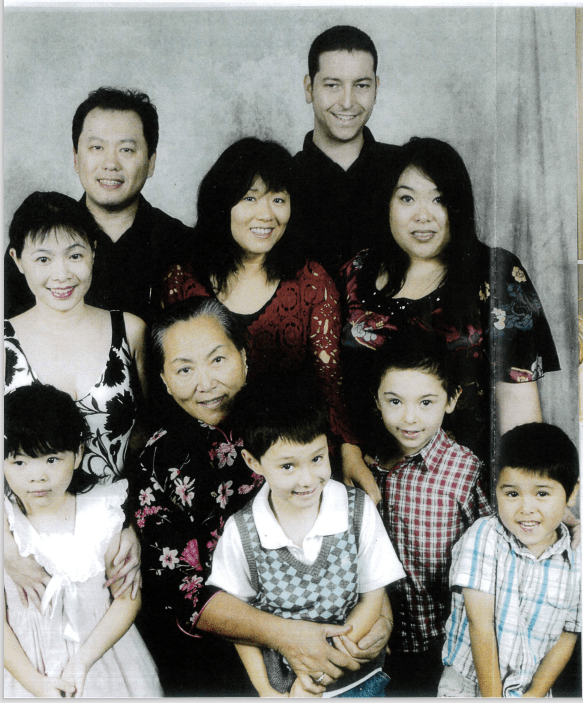
Chen Qi gave up her flourishing career in Hong Kong to work as a dishwasher and open a restaurant in Perth. She sacrificed her delicate hands that had once played the Guzheng and her youthful appearance, and she endured this lifestyle for over 40 years. Fortunately, as the pediatrician had predicted, her children’s asthma never returned. Her children loved and respected their mother deeply, resulting in them being dutiful children.
Holding Up the Sky Like Her Father Did
After immigrating to Perth, Chen Qi not only raised her children but also used her savings and efforts to help her mother, younger brother’s family, and sister’s family immigrate to Perth as well. It seemed as if she knew that her father had entrusted her with the responsibility of supporting the family. She believed that even in the face of great hardships, her father was watching over her from the beyond. No matter how unfairly she was treated, Chen Qi had faith that heaven held a scale, weighing her actions.
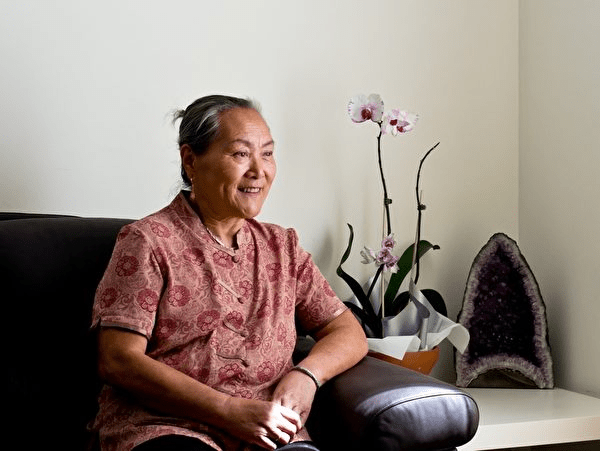
Through 70 years of trials and tribulations, joys and sorrows, Chen Qi now hopes for the right opportunity to publish her autobiography, “Journey of the Guzheng,” so that more people can experience the hardships of life through her story and gain insight into the true meaning of life amidst adversity.







 陳旭@perth