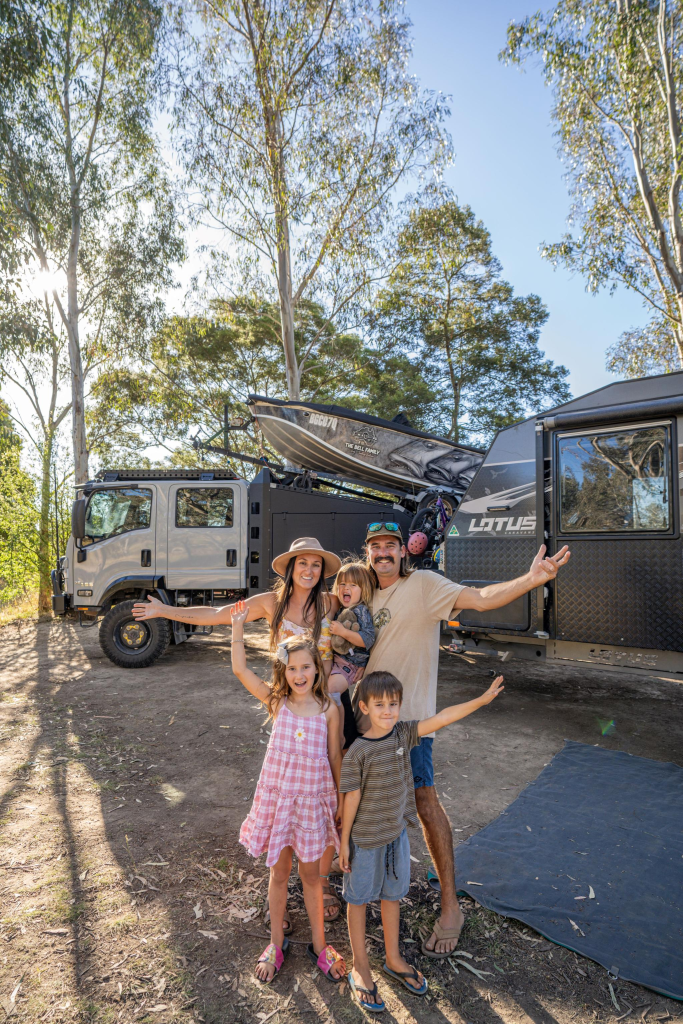
Jack and Amy Bell have been on a never-ending road trip with their three kids for five years now.
And the Queensland family-of-five have no plans to stop travelling anytime soon.
So far, Amy and Jack have clocked up more than 150,000km in their caravan exploring every part of Australia with daughter Elsie, 7, and sons Henry, 5, and Ralph, 3.
To fund their permanent holiday, Amy, 30, and Jack, 31, sold their home and kept an investment property as a “back-up plan”.
Over the years, the family have sustained their adventures by running a full-time shopfitting business along the way.
Jack takes care of the tools, while Amy manages the office side of things while homeschooling the kids on the road.
“Living on the road turned out to be more affordable for us than having a fixed home,” Amy tells 7Life.
Prior to travelling, Jack worked full-time as a shopfitter while Amy was a teacher’s aide.
The couple decided to hit the road and explore their own backyard because they wanted a break from their busy lives.
“We had been managing a mortgage since we were 18, a full house renovation, working full-time, getting married, and raising two children. It was time for us to enjoy some quality family time after years of hard work,” she says.
The pair sold the Gold Coast property they had renovated and used the funds to purchase a caravan.
“We also kept an investment property in Brisbane as a back-up plan,” Amy says.
The family quickly discovered living on the road was much more affordable for them than having a fixed address.
“As we work and travel, we pick up opportunities for work all across Australia,” Amy explains.
“Instead of Jack needing separate accommodation for work, we all travel together in our caravan — eliminating the need for a mortgage payment.
“This new way of life has opened up incredible possibilities for our family.”
Over the past five years, the family has travelled more than 150,000km — exploring every state in Australia multiple times.
However, the couple says downsizing to a smaller space was challenging at first.
“Downsizing to a caravan took some time to get used to, especially with young children and spending so much time together as a couple,” she says.
“After we completed our lap of Australia, we decided to upgrade our set-up to live on the road permanently.
“We now have an Isuzu truck that is divided into two sections.
“One side is equipped with all the tools needed for our shopfitting jobs, while the other side is set up for travel, complete with a fridge, drop-down kitchen, and plenty of fun stuff for the kids.
“We also upgraded our caravan to a spacious 23ft Lotus, which handles off-road adventures like a dream.
“One thing Jack struggled to give up was his boat. With the truck, we have the option to carry a decent-sized boat on top.”
Amy says fishing and exploring in the boat have become integral parts of the family’s travel experience and they “couldn’t imagine travelling without it”.
“Downsizing to a caravan has changed our perspective on life,” she says.
“We have realised how little we actually need. When we eventually settle down, we plan to opt for a smaller property that requires less cleaning and maintenance.”
When it comes to budgeting, Amy says it can be a challenge as their weeks vary greatly.
“Some weeks, we are focused on work and spend minimally, while other weeks involve long drives and stops to explore along the way,” she says.
While there are challenges on the road, the family have found ways to overcome them.
One of the hardest parts was not being close to their loved ones.
“Missing family is one challenge but they often visit us, making those reunions extra special. Technology has also been a great help, allowing us to FaceTime and stay connected,” Amy says.
“Managing appointments can be a challenge, but with Telehealth we have weekly Zoom appointments.”
What makes the challenges worth it is being able to wake up to a new location every day.
“Whether it’s an ocean view or mountains, there’s always something new for the kids to explore and have fun with,” Amy says.
A typical day for the family starts with coffee, getting the kids ready and then an hour of homeschooling.
“The kids like to make their own breakfast and then get dressed,” she says.
“We enjoy some TV, have breakfast, and then dive into homeschooling.”
Once school is over, the family pack their bags and head off in the truck or boat to explore.
“We have lunch packed in the truck fridge, so we’re always prepared for wherever the day takes us,” Amy says.
If they have work to do, Jack leaves early and Amy and the kids take the morning at a slower pace.
Amy usually takes care of household tasks such as cleaning, cooking, and gathering content for their social media while the kids often play with friends or head to a swimming pool.
The family have no plans to stop travelling around Australia any time soon and says the past five years have “flown by”.
“We still have many more adventures ahead of us, but we also have a few remote places on our bucket list that we’re excited to visit,” Amy says.
Next on the family’s list is to explore Western Australia in more detail.
“It’s the state where we’ve spent the least amount of time, but it’s also the largest,” she says.
The couple already have an investment property renovation project lined up in Perth over Christmas, which they are looking forward to.
By sharing their story, the family hopes others are inspired to follow suit.
“Our advice to families considering a travel adventure is simple: just go for it,” Amy says.
“The timing will never feel perfect to leave behind the normalcy of everyday life, but the memories and experiences will be worth it.
“Don’t over plan and instead enjoy wherever the open road takes you.”
When you imagine a sex addict, what do you think of? Is the person suave or seedy?
The ultimate player or unashamedly predatory? A smooth, sophisticated James Bond type, or a rapacious lothario like Russell Brand?
Chances are that whoever springs to mind, they’ll most likely be male. Well, cast aside all those preconceptions and any others you might have, and look at me. I am a sex addict – currently in recovery.
That’s right: I’m a 41-year-old mother – with an eight-year-old daughter – who’s been happily married for a decade to a husband I adore.
I’m middle class and live a pretty ordinary life filled with school runs, children’s activities and work meetings – like many people reading this.
But what you won’t know by looking at me is that I spent more than 20 years in the grip of a destructive sex addiction.
Only after thousands of pounds of therapy, steely determination and the unwavering support of my husband am I now, thankfully, in control of the compulsive sexual behaviour, as it is formally known – which I know now was rooted in early puberty.
In my 20s, I spent hours compulsively watching hardcore pornography and putting myself in unspeakably dangerous situations with men, sabotaging every meaningful relationship I had.
I ruined a three-year one with a wonderful man I thought I’d marry, after some sleazy encounter with an ex-boyfriend on a solo trip to Hawaii after graduating.
Although he probably never would have found out, I broke up with him because I felt so guilty and disgusted with myself. I always felt bad about my behaviour, during and especially afterwards, but I just couldn’t stop. If sex was proffered, I didn’t care what format it came in, I was compelled to seize it.
What does a sex addiction feel like? It’s a question I’ve often been asked. Well for a start, sex addiction is never sexy.
I describe it as an urge that’s out of my control; to be constantly consumed with the desire for the physical release of orgasm, and also for affection.
Sex made me feel valuable, a feeling I was addicted to, but didn’t know how to find without intercourse.
Orgasm was a sensation so powerful that it obliterated worry, anxiety, self-loathing, fear and insecurity for a short while. And – something all addicts will identify with – as soon as it was over I’d immediately be craving the next hit. Having scrutinised my sexual history through therapy, I’ve realised I always sought comfort in sex when I was stressed, fearful, bored or anxious because it was easier than dealing with the feelings themselves.
I know inevitably people will ask how many men I’ve slept with, and while I do understand their curiosity, I don’t believe the number is relevant or helpful.
Before I met my husband more than 11 years ago, there were times I’d sleep with a new guy every week when I was single but, more typically, I’d jump from one monogamous relationship to the next (ranging from three months to three years) with sex always the focus.
Also, the ‘how many’ figure is just one of a number of elements that make up this complex disorder. It’s one of the reasons I’m so open when documenting my experiences in my memoir, because compulsive sexual behaviour is frequently misunderstood.
Difficult to officially diagnose – after all, how do you differentiate sex addiction from someone with a strong sexual appetite and weak willpower?
It’s defined by relationship charity Relate as ‘any sexual behaviour that feels out of control.
It’s not the behaviour itself that defines it as a compulsion but rather the dependency on it to numb out negative emotions and difficult experiences.’ Like most other adolescents with raging hormones, my enthusiasm for sex began perfectly normally when I discovered masturbation aged 12.
Raised by Catholic parents, I went to an all-girls’ religious school where sex was taboo and only ever mentioned at home and in the classroom in relation to procreation.
This meant that very early on I associated sex with shame, not least when, also aged 12, I was diagnosed with scoliosis – curvature of the spine – and immediately assumed it was God’s way of punishing me for touching myself ‘down there’.
This was the point at which normal, healthy sexual exploration became a compulsion, though I didn’t realise this at the time as I was too young to make sense of my behaviour.
Bullied at school for wearing a back brace to correct my spinal condition, masturbation was an escape and orgasm my primary release and coping mechanism.
This was all happening around the time that the internet was becoming more accessible. I started with viewing and downloading pornographic images, then videos, before moving on to streaming porn and graduating to cyber-sex with strangers.
All this was going on in my parents’ house, late at night with my bedroom door locked, the fear of being interrupted part of the thrill.
I’d feel sick with shame afterwards and vow never to do it again. But I always did, often within hours. I lost my virginity, aged 17, to a man who was ten years older than me and a regular customer at the restaurant where I worked after school.
I can’t say it was a particularly pleasurable experience for me as I was focused on pleasing him – but the thrill, shame and self-disgust was still there. When I went to college to study English literature aged 18, I suddenly had much more access to men, flitting between casual sex and relationships.
Privately, porn remained a constant, giving me the combination of pleasure and shame I craved.
Only now can I see that the most destructive part of my addiction was this ever-present aspect of shame. If I’d known as a young person that it was normal and healthy to be interested in sex, I probably wouldn’t have developed an addiction.
Shame was the driving force. Though I only cheated on boyfriends a handful of times, I would often fantasise about doing so and was always flirtatious with other men.
Relationships would end at the same sad place: with me walking away if I felt a man was getting too close, because emotional intimacy felt too risky and alien.
I felt too dirty and shameful for anyone to love and feared they’d reject me once they knew me properly.
In my late 20s, a boyfriend who was a successful film director and much older than me planted the seed that my insatiable sexual appetite wasn’t healthy.
I constantly pestered him for sex even when he said ‘no’ because I didn’t know how to connect with him, or anyone else, any other way.
After I’d pestered him for the umpteenth time one day, he yelled at me: “You’re a sex addict, you need to get some help!”
We separated, and although it was a few years before I started therapy, it had alerted me to the fact that something wasn’t quite right with my attitude to sex.
Just before I turned 30, I’d broken up with a man I loved but cheated on and I realised I wanted the next decade of my life to be different.
If I was going to change, I needed to be single for a while and abstain from sex until I was mentally healthier.
On a mission to become a better version of myself, I went on holiday to Bali where I spent my time doing yoga, meditation and reflection classes.
That’s where I met my husband, River, an Australian who was working in Shanghai at the time.
When we spoke after a yoga class I was scared of the attraction I felt for him due to my determination to be single for a while.
Still, when I bumped into him again a few days later I agreed to go out for drinks. We had sex on our second date, after which I was filled with a mixture of fear that I’d fall back into my destructive ways, along with excitement and infatuation.
We swapped numbers and emails and, two weeks later, back home, I decided to do something I’d never done in any relationship – I told River everything: that I suspected I was a sex addict.
Convinced he would simply cut me off at that point, I was amazed when he didn’t. Determined this relationship wouldn’t follow the same destructive pattern, I went to a few Sex and Love Addicts Anonymous (SLAA) meetings to learn how to have healthier relationships, establish new patterns of behaviour, and meet other people having similar experiences.
Like Alcoholics Anonymous, SLAA is a 12-step programme where people share experiences of addiction and support one another in sobriety, with meetings available all over the UK.
My biggest fear for years had been of being found out, that people might think I was sick and depraved and I’d be alone for ever.
The realisation that my compulsive sexual behaviour didn’t mean I was a terrible person was a relief, as was the hope that meeting other addicts gave me. Many had gone on to have healthy relationships, so maybe I could, too.
Therapy taught me that revealing the darkest thing about yourself to other people is empowering because it takes the power away from the addiction.
So I kept confessing, going to more meetings and therapy. River and I reunited in Thailand before going travelling together for several months.
No matter what I confessed, he never judged me or backed away.
It brought us closer. He was warm and had an understanding borne of his own demons, being newly sober from alcohol and drug use at the time.
Over the past decade, I’ve realised the triggers that lead me to seek comfort in sex and porn are stress, fear and anxiety.
I learned to go for a walk, meditate and talk or write about my feelings.
It’s important to be clear that being triggered doesn’t mean feeling like I’ll cheat on my husband. It’s more that something triggers the urge to use sex as a self-soothing mechanism – for example, watching porn to shut out a feeling. If I get this urge, I’ll ask myself: am I running away from something, or do I just feel like watching it?
Very occasionally, I do watch porn. But only because I want to, not because I need to.
There’s a healthy and unhealthy way to approach the same activity and being in recovery means knowing the difference.
In 2013, River and I wed. Sex remains a focus of my marriage but it’s healthy and loving. I’m very much a recovering sex addict as my impulses and activities are no longer out of control, risky or secretive.
You can be a healthy and empowered sexual person who practises safe sex with hundreds of people and not necessarily be addicted to sex. You just like sex, but you don’t lie to people or use sex as an escape or a coping mechanism because you can’t face issues in your life.
On the other hand, you can be in a monogamous marriage and compulsively watch porn in secret or have sex with strangers behind your spouse’s back and feel ashamed and out of control.
My therapy is ongoing and has helped me realise I’d been using sex to mask feelings of rejection and self-hatred I first felt aged 12.
It also taught me that instead of running from complicated feelings, I can now talk about them and trust they will pass.
I am in a healthy place now. It’s more than ten years since I felt the desire to blow up my life, lie, cheat, or destroy my relationship – and for that I can only be proud and grateful.
Six years ago I celebrated my 68th birthday by gifting my children 68 bits of advice I wished I had gotten when I was their age. Every birthday after that I added more bits of advice for them until I had a whole book of bits. That book was published a year ago as Excellent Advice for Living, which many people tell me they read very slowly, just one bit per day. In a few days I will turn 73, so again on my birthday, I offer an additional set of 101 bits of advice I wished I had known earlier. None of these appear in the book; they are all new. If you enjoy these, or find they resonate with your own experience, there are 460 more bits in my Excellent Advice book, all neatly bound between hard covers, in a handy size, ready to gift to a person younger than yourself. – KK
• Try to define yourself by what you love and embrace, rather than what you hate and refuse.
• 盡量用你熱愛和擁抱的東西來定義自己,而不是你恨和拒絕的東西。
• Read a lot of history so you can understand how weird the past was; that way you will be comfortable with how weird the future will be.
• 多閱讀一些歷史,這樣你就能了解過去是多麼的奇怪,這樣你就會對未來的奇怪感到放鬆。
• To make a room luxurious, remove things, rather than add things.
• 要讓房間豪華,不要添加東西,而是移走東西。
• Interview your parents while they are still alive. Keep asking questions while you record. You’ll learn amazing things. Or hire someone to make their story into an oral history, or documentary, or book. This will be a tremendous gift to them and to your family.
• If you think someone is normal, you don’t know them very well. Normalcy is a fiction. Your job is to discover their weird genius.
• 如果你認為某人很正常,那你就不太了解他們了。正常只是一種虛構。你的工作是發現他們奇怪的天賦。
• When shopping for anything physical (souvenirs, furniture, books, tools, shoes, equipment), ask yourself: where will this go? Don’t buy it unless there is a place it can live. Something may need to leave in order for something else to come in.
• You owe everyone a second chance, but not a third.
• 每個人都應該得到第二次機會,但不是第三次。
• When someone texts you they are running late, double the time they give you. If they say they’ll be there in 5, make that 10; if 10, it’ll be 20; if 20, count on 40.
• Multitasking is a myth. Don’t text while walking, running, biking or driving. Nobody will miss you if you just stop for a minute.
• 多工作能力是一種謬論。走路、跑步、騎車或開車時不要發簡訊。即使你暫時停下來,也沒人會錯過你。
• You can become the world’s best in something primarily by caring more about it than anyone else.
• 你可以透過比任何人都更關心某件事來成為這方面的世界第一。
• Asking “what-if?” about your past is a waste of time; asking “what-if?” about your future is tremendously productive.
• 追問過去的”如果”是在浪費時間,追問未來的”如果”非常有成效。
• Try to make the kind of art and things that will inspire others to make art and things.
• 努力創作出能激發其他人創作的藝術品和東西。
• Once a month take a different route home, enter your house by a different door, and sit in a different chair at dinner. No ruts.
• 每個月都要改變一次回家的路線,從不同的門進入房子,並在晚餐時坐在不同的椅子上。不要坐穩了腳步。
• Where you live—what city, what country—has more impact on your well being than any other factor. Where you live is one of the few things in your life you can choose and change.
• Every now and then throw a memorable party. The price will be steep, but long afterwards you will remember the party, whereas you won’t remember how much is in your checking account.
• Most arguments are not really about the argument, so most arguments can’t be won by arguing.
• 大多數爭論實際上並不是針對爭論本身,因此大多數爭論都無法透過爭論來贏得勝利。
• The surest way to be successful is to invent your own definition of success. Shoot your arrows first and then paint a bull’s eye around where they land. You’re the winner!
• 成功的最可靠方法是自行定義成功的標準。先射出箭,再在箭射中的地方畫一個靶心。你就是贏家!
• When remodeling a home interior use big pieces of cardboard to mock-up your alterations at life size. Seeing things, such as counters, at actual size will change your plans, and it is so much easier to make modifications with duct tape and scissors.
• There should be at least one thing in your life you enjoy despite being no good at it. This is your play time, which will keep you young. Never apologize for it.
• Changing your mind about important things is not a consequence of stupidity, but a sign of intelligence.
• 改變對重要事物的看法並不是由於愚蠢,而是智慧的表現。
• You have 5 minutes to act on a new idea before it disappears from your mind.
• 你只有 5 分鐘的時間去實踐一個新想法,否則它會從你的腦海中消失。
• What is important is seldom urgent and what is urgent is seldom important. To get the important stuff done, avoid the demands of the urgent.
• 重要的事情往往不緊急,緊急的事情往往不重要。要完成重要的事情,就要避開緊急事物的要求。
• Three situations where you’ll never regret ordering too much: when you are pouring concrete, when you are choosing a battery, and when you are getting ice for a party.
• 在下列三種情況下,你永遠不會後悔訂購過多 : 澆築混凝土時、選購電池時以及為派對採購冰塊時。
• The patience you need for big things, is developed by your patience with the little things.
• 對大事耐心等待的能力,是由對小事耐心堅持培養而來的。
• Don’t fear failure. Fear average.
• 不要害怕失敗,而要害怕平庸。
• When you are stuck or overwhelmed, focus on the smallest possible thing that moves your project forward.
• 當你遇到困難或不知所措時,請專注於推進計劃的最小可能的事情。
• In a museum you need to spend at least 10 minutes with an artwork to truly see it. Aim to view 5 pieces at 10 minutes each rather than 100 at 30 seconds each.
• For steady satisfaction, work on improving your worst days, rather than your best days.
• 為了獲得持久的滿足感,努力改善你最糟糕的日子,而不是你最好的日子。
• Your decisions will become wiser when you consider these three words: “…and then what?” for each choice.
• 當你在考慮每個選擇時,把”…然後呢?”這三個字放在心上,你的決策就會變得更加明智。
• If possible, every room should be constructed to provide light from two sides. Rooms with light from only one side are used less often, so when you have a choice, go with light from two sides.
• When you find yourself procrastinating, don’t resist. Instead lean into it. Procrastinate 100%. Try to do absolutely nothing for 5 minutes. Make it your job. You’ll fail. After 5 minutes, you’ll be ready and eager to work.
• If you want to know how good a surgeon is, don’t ask other doctors. Ask the nurses.
• 如果你想知道一位外科醫生的水平如何,不要問其他醫生,要問護士。
• There is a profound difference between thinking less of yourself (not useful), and thinking of yourself less (better).
• 看低自己(無益)與少思自己(更好)之間存在著深刻的區別。
• Strong opinions, clearly stated, but loosely held is the recipe for an intellectual life. Always ask yourself: what would change my mind?
• 明確陳述強烈的觀點,但也要輕易改變,這是從事智力生活的秘訣。永遠問自己:什麼會改變我的想法?
• You can not truly become yourself, by yourself. Becoming one-of-a-kind is not a solo job. Paradoxically you need everyone else in the world to help make you unique.
• If you need emergency help from a bystander, command them what to do. By giving them an assignment, you transform them from bewildered bystander to a responsible assistant.
• The most common mistake we make is to do a great job on an unimportant task.
• 我們最常犯的錯誤是,在一項不重要的任務上做得很出色。
• Don’t work for a company you would not invest money in, because when you are working you are investing the most valuable thing you have: your time.
• 不要為你不會投資的公司工作,因為當你在工作時,你正在投資最寶貴的東西:你的時間。
• Fail fast. Fail often. Fail forward. Failing is not a disgrace if you keep failing better.
• 快速失敗。經常失敗。向前失敗。如果你持續改進,失敗並不可恥。
• Doing good is its own reward. When you do good, people will question your motive, and any good you accomplish will soon be forgotten. Do good anyway.
• For every success there is a corresponding non-monetary tax of some kind. To maintain success you have to gladly pay these taxes.
• 每一次成功都會有相應的非金錢性的代價。要維持成功,你必須樂於支付這些代價。
• Do not cling to a mistake just because you spent a lot of time making it.
• 不要僅僅因為花了很多時間而堅持錯誤。
• For small tasks the best way to get ready is to do it immediately.
• 對於小任務來說,最好的準備方式就是立即去做。
• If someone is calling you to alert you to fraud, nine out of ten times they are themselves the fraudster. Hang up. Call the source yourself if concerned.
• When you try to accomplish something difficult, surround yourself with friends.
• 當你嘗試完成困難的事情時,應該讓朋友們環繞在你身邊。
• You should be willing to look foolish at first, in order to look like a genius later.
• 你應該願意一開始看起來很愚蠢,從而最終看起來像個天才。
• Think in terms of decades, and act in terms of days.
• 用十年的時間思考,用一天的時間行動。
• The most selfish thing in the world you can do is to be generous. Your generosity will return you ten fold.
• 世界上最自私的事就是大方慷慨。你的慷慨將會帶給你十倍的回報。
• Discover people whom you love doing “nothing” with, and do nothing with them on a regular basis. The longer you can maintain those relationships, the longer you will live.
• 發現你喜歡和誰”無所事事”,並經常與他們無所事事。能夠維持這些關係越長久,你的生命就會越長久。
• Forget diamonds; explore the worlds hidden in pebbles. Seek the things that everyone else ignores.
• 忘掉鑽石吧,探索隱藏在石子中的世界。尋找別人忽視的事物。
• Write your own obituary, the one you’d like to have, and then everyday work towards making it true.
• 給自己寫一份你希望得到的訃文,然後每天努力實現它。
• Avoid making any kind of important decision when you are either hungry, angry, lonely, or tired (HALT). Just halt when you are HALT.
• 當你飢餓、憤怒、孤獨或疲憊(HALT)時,請避免做出任何重要的決定。當你處於 HALT 狀態時,請暫停行動。
• What others want from you is mostly to be seen. Let others know you see them.
• 別人從你這裡要的大多是被看見。讓別人知道你看見了他們。
• Working differently is usually more productive than working harder.
• 不同的工作方式通常比更加努力工作更有成效。
• When you try something new, don’t think of it as a matter of success / failure, but as success / learning to succeed.
• 當你嘗試新事物時,不要把它看作成功/失敗的問題,而是把它看作成功/學習如何成功。
• If you have a good “why” to live for, no “how” will stop you.
• 如果你有一個好的活著的”理由”,沒有任何”方式”能阻止你。
• If you are out of ideas, go for a walk. A good walk empties the mind—and then refills it with new stuff.
• 如果你缺乏靈感,就去散步吧。一次好的散步能讓你的思緒變得清晰,然後再次充滿新的東西。
• The highest form of wealth is deciding you have enough.
• 最高形式的財富是決定你已經擁有足夠的東西。
• Education is overly expensive. Gladly pay for it anyway, because ignorance is even more expensive.
• 教育的費用過於昂貴。不過還是樂意為此付出代價,因為無知的代價更高。
• The cheapest therapy is to spend time with people who make you laugh.
• 最便宜的療程就是花時間和那些能讓你開懷大笑的人在一起。
• Always be radically honest, but use your honesty as a gift not as a weapon. Your honesty should benefit others.
• 永遠要徹底誠實,但要把你的誠實當作一份禮物,而不是武器。你的誠實應該讓別人受益。
• A good sign that you are doing the kind of work you should be doing is that you enjoy the tedious parts that other people find tortuous.
• 一個好的跡象表明你正在做你應該做的工作,那就是你享受別人覺得極其痛苦的瑣碎部分。
• Being envious is a toxin. Instead take joy in the success of others and treat their success as your gain. Celebrating the success of others costs you nothing, and increases the happiness of everyone, including you.
• The more persistent you are, the more chances you get to be lucky.
• 你越堅持,就越有機會走運。
• To tell a good story, you must reveal a surprise; otherwise it is just a report.
• 要講好一個故事,你必須透露一個驚喜,否則就只是報告而已。
• Small steps matter more when you play a long game because a long horizon allows you to compound small advances into quite large achievements.
• 在長期計劃中,小步伐更為重要,因為長遠來看,你可以將微小的進步累積成相當大的成就。
• If you are more fortunate than others, build a longer table rather than a taller fence.
• 如果你比別人更幸運,就多搭建一張長桌,而不是築起更高的圍牆。
• Many fail to finish, but many more fail to start. The hardest work in any work is to start. You can’t finish until you start, so get good at starting.
• Work on your tone. Often ideas are rejected because of the tone of voice they are wrapped in. Humility covers many blemishes.
• 要注意你的言辭。許多想法之所以被拒絕,往往是因為包裹它們的言辭口吻。謙遜可掩蓋許多瑕疵。
• When you are right, you are learning nothing.
• 當你是對的時候,你就什麼也沒有學到。
• Very small things accumulate until they define your larger life. Carefully choose your everyday things.
• 很小的事物會持續累積,直到定義你更大的生活。要小心選擇你的日常事物。
• It is impossible to be curious and furious at the same time, so avoid furious.
• 好奇心和憤怒是不可能同時存在的,所以要避免憤怒。
• College is not about grades. No one cares what grades you got in college. College is about exploring. Just try stuff.
• 大學不在於成績。沒有人在乎你在大學裡拿了什麼成績。大學是為了探索。就去嘗試各種事物吧。
• Weird but true: If you continually give, you will continually have.
• 奇怪但真實:只要你持續給予,你就會持續擁有。
• To clean up your city, sweep your doorstep first.
• 要打掃你的城市,先從掃你家門口開始。
• Decisions like to present themselves as irreversible, like a one-way door. But most deciding points are two-way. Don’t get bogged down by decisions. You can usually back up if needed.
• You’ll never meet a very successful pessimistic person. If you want to be remarkable, get better at being optimistic.
• 你永遠不會遇到一個非常成功的悲觀主義者。如果你想要非凡,就要更擅長樂觀。
• You can’t call it charity unless no one is watching.
• 除非沒人在看,否則你不能稱之為慈善。
• When you think of someone easy to despise—a tyrant, a murderer, a torturer—don’t wish them harm. Wish that they welcome orphans into their home, and share their food with the hungry. Wish them goodness, and by this compassion you will increase your own happiness.
• Get good at being corrected without being offended.
• 要學會在被糾正時不生氣。
• The week between Christmas and New Years was invented to give you the perfect time to sharpen your kitchen knives, vacuum your car, and tidy the folders on your desktop.
• There is no formula for success, but there are two formulas for failure: not trying and not persisting.
• 成功沒有公式,但有兩個失敗的公式:不嘗試和不堅持。
• We tend to overrate the value of intelligence.You need to pair your IQ with other virtues. The most important things in life can not be attained through logic only.



 陳旭@perth