DOJ Says Epoch Times Newspaper Is an Epic Money-Laundering Operation
Portrait of Matt Stieb By Matt Stieb, Intelligencer staff writer
One of the strangest stories in media over the past decade is the Epoch Times, a formerly free newspaper distributed on the streets of New York that focuses on conspiracist, right-wing takes and reports that are extremely critical of the Chinese Communist Party. Founded in 2000, it effectively functions as a propaganda wing of Falun Gong, the religious movement headquartered upstate that is also behind Shen Yun, the anti-communist show with the inescapable subway ads. During the Trump years, the Epoch Times successfully expanded its operation on YouTube and Facebook, reaching millions of Americans with clickbait and misinformation. According to the Justice Department, it also functioned as a massive money-laundering scheme for one of its executives.
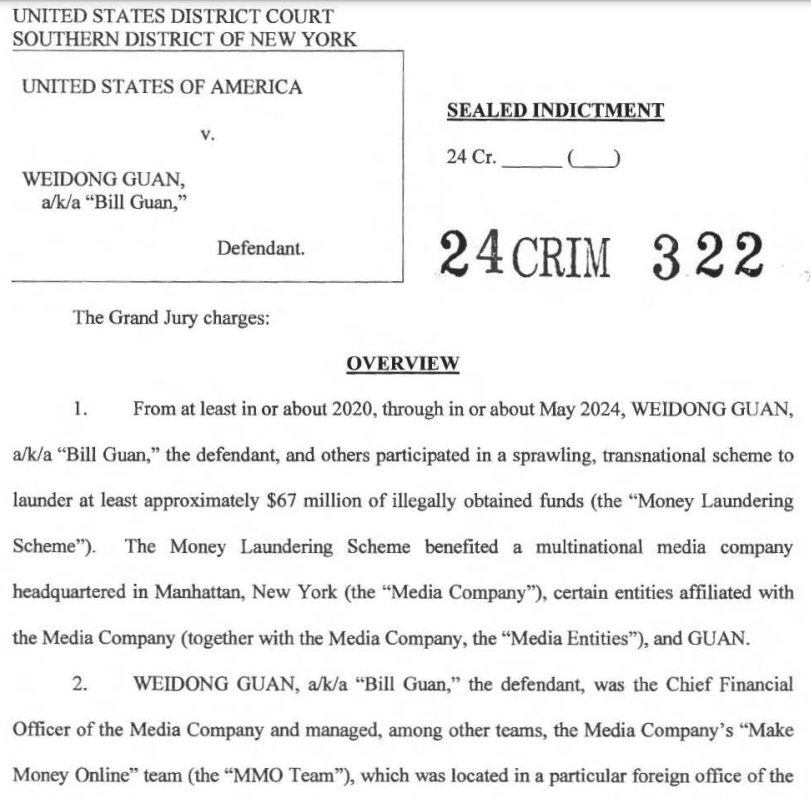
On Monday, federal prosecutors in New York charged the Epoch Times’ chief financial officer, Bill Guan, with bank fraud and conspiracy to commit money laundering for allegedly moving at least $67 million in illegally obtained funds to bank accounts in the media outlet’s name. According to the indictment, Guan was in charge of something (rather suspiciously) called the “Make Money Online” team, in which Guan and underlings “used cryptocurrency to knowingly purchase tens of millions of dollars in crime proceeds.” The alleged scheme was fairly simple, relying on prepaid debit cards, which are a common method in crypto laundering. The Make Money Online team, based abroad, would allegedly purchase “proceeds of fraudulently obtained unemployment insurance benefits” loaded onto prepaid cards. The team then allegedly traded them for cryptocurrency at 70 to 80 percent of the cards’ actual value. After making the deal, the Feds claim that those funds would then be transferred into bank accounts associated with the Epoch Times as well as into Guan’s personal bank accounts.
It appears that the Make Money Online team lived up to its name. The Feds say that at the same time that Guan allegedly concocted the money-laundering scheme, the Epoch Times’ annual revenue shot up 410 percent, from $15 million to around $62 million. Its bankers naturally had questions, but Guan said that the windfall came from donations, per the indictment. (Unfortunately for him, he also wrote to a congressional office in 2022, stating that donations are “an insignificant portion of the overall revenue” of the Epoch Times.) Guan has entered a not guilty plea, and prosecutors note that the “charges do not relate to the Media Company’s newsgathering activities.”
Amid a big surge to record levels and wild gyrations, bitcoin is back in mainstream consciousness. Whether or not that lasts may be dependent on what the US Federal Reserve does or doesn’t do this year.
Overnight, bitcoin briefly topped $US69,000 ($106,000) before tumbling back to around $US64,000. At its peak, the cryptocurrency had soared nearly 80 per cent in the past year and more than 300 per cent from its recent nadir in November 2022.
There are some crypto-specific factors in the resurgence of the flagship for crypto assets, the most significant of which has been the US Securities and Exchange Commission’s begrudging decision to approve the spot trading of bitcoins by exchange-traded funds (ETFs) in January.
That approval came after a court ruling last August that the commission had improperly denied an application from an asset manager to create a bitcoin ETF.
It was that judgement that rekindled the market for bitcoin and which has seen the market capitalisation of crypto assets double, from about $US1.2 trillion before the ruling to around $US2.4 trillion this week.
The ETFs have attracted about $US15 billion of inflows in two months, with major asset managers like BlackRock involved. That’s given bitcoin a tinge of mainstream credibility it previously didn’t have, and one which looked impossible when, after peaking at almost $US3 trillion in 2022, the crypto market crashed amid a wave of collapses and scandals. Bitcoin was trading below $US16,000 in late November of that year.
The other crypto-related influence over recent bitcoin prices has been the imminent “halving” of the number of coins that can be “mined,” an event that occurs every four years and which restricts the volume of new coins available to the market.
With new sources of demand created by the ETFs, which make it simpler and less risky for investors to trade bitcoins than the complex, cumbersome and demonstrably risky system of digital wallets and intermediaries with questionable credentials, the halving will tighten supply.
The introduction of the ETFs and the halving, which will occur next month, are, however, the micro influences on bitcoin’s price. The more powerful macro influence is the direction of US interest rates.
It is no coincidence that the tanking of bitcoin’s price, and those of crypto assets more generally, occurred during a period when the Fed was ratcheting up US interest rates, and with its quantitative tightening (allowing bonds and mortgages it acquired during the pandemic to mature without investing the proceeds), tightening US financial conditions.
The slump in the value of crypto assets roughly coincided with the start of the Fed’s rate-hiking cycle in March 2022. Eleven rate rises that took the federal funds rate from effectively zero to 5.5 per cent over about 15 months batter all risk assets, not just crypto assets. The US sharemarket fell more than 20 per cent in the months after the Fed’s first move.
Perhaps because the crypto ecosystem was mired in collapses and controversies through the back half of 2022 – the collapse of TerraUSD, the collapse of FTX and the arrests of Sam Bankman-Fried and Binance’s founder and chief executive Changpeng Zhao among them – crypto prices started moving much later than the sharemarket, which started to rebound from mid-October 2022.
That rebound was turbocharged by the launch of ChatGPT in November of that year, which ignited feverish trading of stocks with artificial intelligence exposures and drove the sharemarket to record levels this year.
The sharemarket’s surge, however, wasn’t just driven by AI or the big tech stocks but by a conviction that the Fed would start cutting interest rates this year, with the bond market at one point early in the year pricing in as many as six 25-basis-point reductions.
That optimism took a hit at the end of January when, after a Fed meeting, it became apparent that, rather than the March cut that some had anticipated, the central bank’s commentary probably ruled out any change in policy until mid-year at the earliest.
Despite that, investors in risk assets remained convinced that rates would start to fall and fall quite materially this year.
Weak economic data for February released over the past few days – data perceived to have strengthened the case for rate cuts – was a major factor in the ebullient performance of bitcoin on Tuesday, which contrasted with the performance of the sharemarket, which fell as the data suggested the prospect of a soft landing for the US economy might be receding.
Sharemarket investors have been pricing in the perfect outcome of interest rates falling even as the US economy continues to grow solidly. The latest data raises a question mark over whether they can have both.
Bitcoin is, on the spectrum of risk assets, at the riskiest end and, with significant leverage underlying its trading, highly leveraged to changes in the risk environment. On Tuesday, the environment was very much one of “risk on.”
That underscores bitcoin’s role as a vehicle for pure speculation. It has no intrinsic value. It isn’t any sort of medium for exchange (except, perhaps, for illegal activity). It is, however, an asset that provides a way to make leveraged bets on a risk environment that is being driven by expectations of what the Fed may or may not do in the relatively near future.
It is notable that, year-to-date, the NYFANG index, which includes all the big tech companies and has been boosted by the frenzy over AI, is up just under 12 per cent. Bitcoin is up more than 50 per cent. That’s leverage!
While the market for bitcoin has been structurally changed by the introduction of the ETFs, which brings with it a degree of institutionalisation of the market, it is the macro settings and what happens to US interest rates in future that will determine whether its surge continues or whether it falls back into the boom and bust cycles that have characterised its past.
The volatility of trading on Tuesday and early Wednesday – up about 6 per cent and then down nearly 8 per cent against the 2.3 per cent fall in the rate-sensitive big tech stocks – does tend to signal, however, that it will remain among the most volatile and riskiest of risk assets.
The finance world is abuzz with the news that the powerful US financial regulator has finally given its stamp of approval for bitcoin exchange-traded funds (ETFs), sending the price of the cryptocurrency soaring and enthusing investors in the nascent asset class.
So what does the move mean for bitcoin, and how will it affect investors in Australia?
What is bitcoin?
Bitcoin and other cryptocurrencies are a type of digital currency that uses blockchain technology to track and process transactions.
It was developed in 2008 by an anonymous person or group of people known only as Satoshi Nakamoto, with the goal of being an electronic version of cash that does not require a central financial institution such as a bank.
Bitcoin transactions are powered by an interlinked web of computers across the globe that are responsible for verifying, cross-referencing and processing transactions on the network.
Every 10 minutes, these transactions are packaged into a “block”, which is linked to the block before it – hence the term “blockchain”.
These blocks are unable to be modified or changed, and give cryptocurrencies such as bitcoin the credentials of being transparent, traceable, immutable, and very difficult to dupe.
What is an ETF?
Sharemarkets such as the Australian Securities Exchange (ASX) offer a number of shares that investors can purchase including well-known local companies such as Telstra or Woolworths.
However, investors can also opt to purchase exchange-traded funds, which are bought and sold just like shares, but instead of representing a holding in just one company, they track the price of a basket of multiple shares.
For example, if you were to purchase a unit of a popular ETF such as an ASX 200 ETF, you’d be purchasing a small exposure to the top 200 companies on the local bourse, all bundled together into one product.
Investors, especially inexperienced ones, opt for ETFs thanks to their lower risk profile than individual shares, along with the level of diversification they can offer.
What did American authorities decide?
The US Securities and Exchange Commission (SEC) approved 11 applications from major fund managers such as Blackrock, VanEck and Fidelity to issue ETF products that track the price of bitcoin. These products are expected to begin trading as early as this week.
Major funds have been vying to launch bitcoin ETFs for years but have been held back by the SEC, which until now had been concerned over the potential for market manipulation and the general volatility of the asset class.
SEC chair Gary Gensler said in the commission’s statement that the move should not be viewed as an endorsement of cryptocurrency by the SEC.
“Bitcoin is primarily a speculative, volatile asset that’s also used for illicit activity including ransomware, money laundering, sanction evasion and terrorist financing,” he said.
“While we approved the listing and trading of certain spot bitcoin ETP shares today, we did not approve or endorse bitcoin.”
The SEC’s announcement was muddled yesterday after the regulator’s account on X (formerly Twitter) issued an “unauthorised” tweet announcing the decision.
What does this mean for cryptocurrency?
Crypto proponents have hailed the move as a watershed moment for the industry, believing the approval by the influential SEC will further legitimise the asset class, which has long been viewed as volatile and unreliable.
ETF approval will also theoretically allow sophisticated investors and funds to invest in bitcoin in a simpler manner, which supporters again believe will accelerate the cryptocurrency’s path to broader adoption.
“This further opens cryptocurrency to both retail and institutional investors via a traditional financial product,” says the chief executive of local crypto exchange BTCMarkets, Caroline Bowler.
“It is also reasonable to assume that this will expand crypto markets in general, as liquidity follows utility.
“So while this is an historic day for the industry, the impacts will be increasingly felt over time.”
However, the widely expected announcement is unlikely to be the panacea crypto supporters are looking for, as the industry is still recovering after the disastrous collapse of numerous exchanges in 2022, including the $32 billion FTX.
Regulators are still eyeing off many players in the industry, with local enforcer – the Australian Securities and Investments Commission – signalling last year it wouldn’t hesitate to act where needed.
Will there be an Australian offering?
The US regulator’s announcement will likely spur a wave of crypto ETFs locally, with Queensland-based fund Monochrome intending to launch its own offering in the first half of this year.
In late 2022, the ASX amended its listing rules to allow for ETFs tracking the price of bitcoin and ethereum – the second-largest cryptocurrency – however no funds have yet gained approval from the local bourse, which has implemented strict rules to protect investors.
What has the news meant for the price of bitcoin?
Following the announcement, bitcoin’s price rose about 8 per cent to $69,000. A raft of other smaller cryptocurrencies followed suit, with ethereum gaining 14 per cent to $3800.
Despite the SEC’s approval being heavily foreshadowed, investors are betting on the new ETFs introducing a wave of new buyers, which could further increase the asset’s price.




 陳旭@perth