
Exclusive: Report from Independent Schools Australia calls for data collection on student school refusal to better tackle rising absenteeism
A new report has urged the federal government to collect national data on chronic absenteeism and embed layers of support in schools to tackle Australia’s growing student attendance crisis.
The report, provided exclusively to Guardian Australia by Independent Schools Australia (ISA), drew from interviews with academics, mental health clinicians and teachers. It called on the government to implement a multi-tiered system of support (MTSS) to better support children struggling to stay in school.
The approach would allow schools to begin systematically categorising and collecting national data on the reasons for non-attendance.
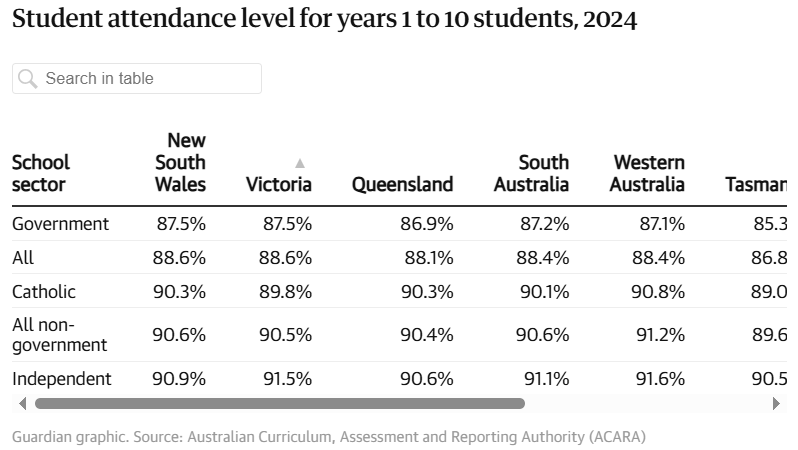
More than 40% of students in years 1 to 10 were missing at least one out of 10 school days, the latest Australian Curriculum Assessment And Reporting Authority data showed.
That rate had steadily worsened over the past five years. In 2019, 73.1% of students were attending at least 90% of school days. In 2024, the figure was just 59.8%, down from 61.6% in 2023.
Attendance also declined by socio-educational advantage and were lower for remote students and Aboriginal and Torres Strait Islander students. Just 35.2% of First Nations students had attendance levels at or above 90% in 2024, compared with about 49% before the pandemic.
The chief executive of ISA, Graham Catt, said there was no national consistency in how non-attendance was defined, recorded or addressed.
“Our new report highlights the need to differentiate types of absenteeism … and calls on the Australian government to lead a cross-sector pilot to test it,” he said.
The report found the term “school refusal” was “misleading” as it suggested a choice, pointing to complex barriers like anxiety, trauma and illness that prevented attendance.
It suggested school refusal often peaked at ages five to six and 10 to 11, during transitions like starting primary or high school or moving schools.
Mainstream schooling may also not be working for young people with additional needs. The report found there had been a 276% increase in enrolments at independent special assistance schools since 2016.
“Absentee recording systems can capture the level of non-attendance but are not nuanced enough to understand the reasons for it,” the report read.
“Schools need to differentiate school refusal from other forms of absenteeism … without a nationally consistent definition … accurate data cannot be collected, and it is difficult for schools to determine when intervention strategies may be required.”
The report said a MTSS model could be implemented to monitor attendance – from occasional absences to chronic disengagement —and help schools respond accordingly. The idea has also been backed by the Australian Education Research Organisation (Aero) after being commissioned by the government to investigate the issue.
Tiered interventions would range from initial whole-school strategies to address wellbeing and belonging, like peer support and anti-bullying programs, to early support interventions for students showing signs of distress and intensive wraparound support for students with complex needs.
For instance, students at a Tier 2 could be offered hybrid attendance or have safe spaces at the school for when they were feeling overwhelmed, while students at Tier 3 may be offered a specialised school support team and external health services.
A Senate inquiry into the issue, initiated by the Greens, released a report in 2023 that recommended a string of measures, including improved access to mental health care and more funding to parent support groups to address the “alarming rate” of absenteeism.
The Senate report noted efforts to tackle school refusal had been hindered by the absence of a nationally consistent and coordinated approach, including a lack of agreed methodology for collecting and reporting on data on chronic absenteeism.
The federal government agreed or supported in principle just two of its 14 proposals, including tasking the Australian Education Research Organisation (Aero) with analysing school refusal and working with governments to embed school refusal training in teaching courses.
Last year, the federal government came under fire from the Greens, peak bodies and experts for refusing to implement the recommendations from the Senate reportto front a national action plan or offer peer support funding to reverse the national trend of school refusal.
A founding board member of School Can’t Australia, Tiffany Westphal, said MTSS was “not the solution in and of itself” and may yield “too little support, too late”.
“Instead of focusing on absence we need to tune into signs of distress which are frequently apparent prior to impacts on attendance,” she said.
But Catt said as it stood schools were being asked to solve the issue “without consistent tools or definitions”.
“We need to rise above politics and blame to do better for students, families, and schools across Australia,” he said.
 陳旭@perth