
It’s so easy to be judgy about people who get caught up in a cult, right? Even if you don’t want to be. I mean, it wouldn’t happen to us. We’d see right through all that weird stuff – like the specific language that means nothing to outsiders, knowing that only believers are on the right path, the rules which make no sense, and the charismatic leader who is clearly a bit off.
That’s what I thought when I started digging around, researching my latest novel that looks behind the walls of The Sanctuary, an imagined closed religious community dedicated to clean, organic living and environmentalism.
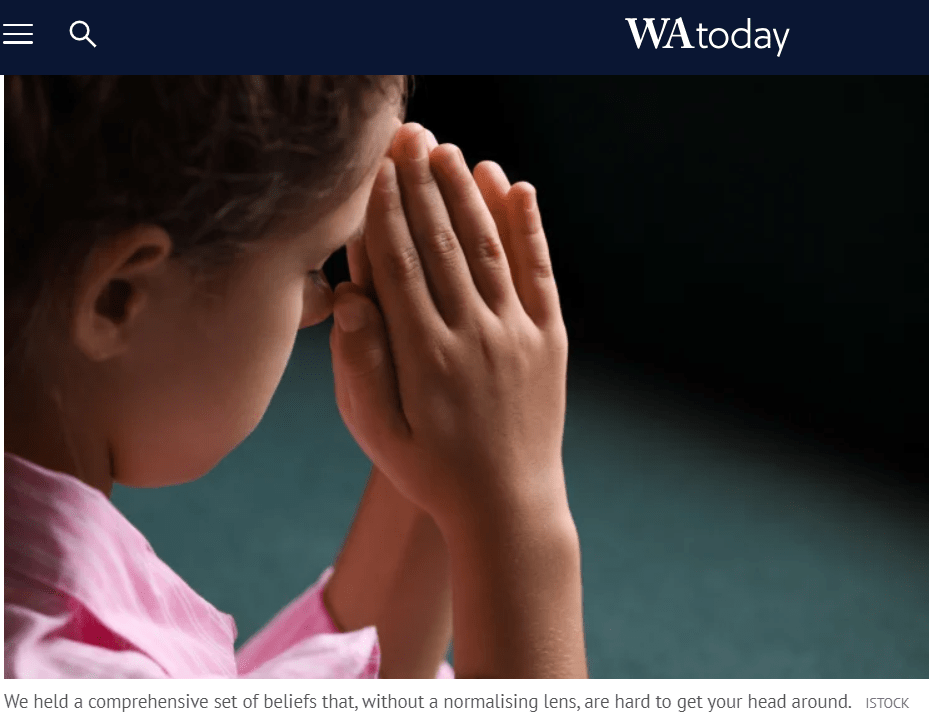
While there may be no single definition of a cult, they share a few potent ingredients, such as general isolation from the rest of society, an unquestioning adherence to a set of beliefs, a strict authoritarian hierarchy of power and a rock-hard sense of being among the chosen ones.Hmmm. I recognised quite a few of those ingredients. I hadn’t joined a cult. But maybe I’d been born into one.I grew up in a large Catholic family on an isolated farm outside Melbourne. I went to a Catholic school, we went to Mass on Sunday, we socialised with other Catholics. We basically didn’t mix with anybody else. We did know one or two non-Catholics and they were nice but they weren’t going to heaven. Not like us.We held a comprehensive set of beliefs that, without a normalising lens, are hard to get your head around. Such as Mary’s virgin birth, eating Christ’s body and drinking his blood, going to hell if you missed Mass on Sunday. We even had a shared language that defined us, such as transubstantiation (bread and wine in the Eucharist becomes Christ’s real body and blood) and the Blessed Trinity (three Gods in one, but really it’s just one God).
We held a comprehensive set of beliefs that, without a normalising lens, are hard to get your head around. Such as Mary’s virgin birth.
Then there were the rules about when you ate and what you ate, such as no eating before Mass, and no meat on Fridays, which I loved because we got to have fish and chips once a week – religiously. You had to regularly confess your sins, which led to considerable pre-reconciliation whispering as us kids figured out which sin we could make up this week.
And most damagingly, there was the unquestioned power of the god-like parish priest. And we all know now what that resulted in. In fact, the 2017 Royal Commission into Institutional Responses to Child Sexual Abuse inquiry identified my parish and the local boy’s secondary college as one of the active centres of paedophilia.
I didn’t question any of these rules and beliefs.
The contest of ideas I discovered at university knocked our brand of Catholicism out of me. Yet, still, years later when I had my own family, the kids eventually did some of the sacraments so they wouldn’t feel too out of place at family church events.
When my youngest child was preparing for their First Reconciliation, we dutifully read the children’s Bible stories from the Old Testament every night as requested. Now this child, who had previously declared that they wanted to be an “evil overlord” when they grew up said to me one night, “Oh mama, I’m getting a lot of good ideas about how to be an evil overlord from God.”
I laughed out loud. I hadn’t seen it before. I had completely normalised that God could legitimately require Abraham to prove his undying devotion by killing his son. Or that it was perfectly acceptable that God would test Job’s excellent piety by taking away his possessions, his family and then his health. Yeah, now that I think about it, my child was spot on: you could say that the God of the Old Testament did abuse his power as leader.
Obviously, it was a unique set of conditions that meant I experienced cult-like conditions as a child. Very few people can now live in that kind of isolation. We have the internet, which beams in all sorts of ideas all the time. As well, the modern Catholic Church has shared leadership between priests and parishioners, so authority no longer rests in a single godlike being.
There are thousands of cults across the world, from self-help cults, to political and religious cults. Many of them don’t look anything like the doomsday cult, Heaven’s Gate, which ended in mass suicide, as members tried to catch a passing comet in 1997. Or Australia’s own Ideal Human Environment, which began in the ’80s as an experiment in happiness, harmony and ideal living. In 2019, leader James Salerno was imprisoned for unlawful sexual intercourse with a child, and the truth about the abuse behind those closed doors was exposed. The IHE had been operating for 30 years.
None of us joins a cult – we join a movement to make ourselves and the world a better place. But my experience taught me that it’s a fine line between intentional community and cult. That line is defined by how power is exercised.
So, whether you’re seeking your own happiness, or a new way of making the world a better place, like that great meditation group you just joined or that conspiracy idea that is sweeping around you, take care. Watch what happens when you ask questions. If they close you down, or make you feel guilty for asking in the first place, I’m guessing it is a good idea to keep asking those questions.
人们很容易对陷入邪教的人评头论足,对吗?即使你并不想这样。我是说,这种事不会发生在我们身上。我们会一眼看穿那些怪异的东西–比如对外人毫无意义的特定语言,知道只有信徒才走在正确的道路上,那些毫无意义的规则,以及那个魅力十足但明显有点不正常的领袖。
当我开始四处挖掘、研究我的最新小说时,我就是这么想的。这部小说描写了 “圣所 “高墙背后的故事。”圣所 “是一个想象中的封闭的宗教社区,致力于清洁、有机的生活和环保。
虽然对邪教可能没有一个统一的定义,但它们都有一些共同的要素,比如与社会其他部分的普遍隔离、对一套信仰的不容置疑的坚持、严格的专制权力等级制度以及坚如磐石的 “被选中者 “意识。
嗯。我认出了其中的一些成分。我没有加入邪教。但也许我生来就是一个。
我在一个天主教大家庭里长大,家在墨尔本郊外一个与世隔绝的农场。我上的是天主教学校,我们周日去做弥撒,和其他天主教徒交往。我们基本上不和其他人来往。我们确实认识一两个非天主教徒,他们人很好,但他们不会上天堂。和我们不一样。
我们有一套完整的信仰,如果没有一个正常化的视角,你很难理解这些信仰。比如马利亚的处女之身,吃基督的身体喝他的血,错过周日的弥撒就会下地狱。我们甚至有共同的语言来定义我们自己,比如 “变体”(圣餐中的面包和酒变成了基督真正的身体和血液)和 “三位一体”(三位神合一,但实际上只有一位神)。
我们持有一整套信仰,如果没有一个正常化的视角,你很难理解这些信仰。比如马利亚的处女之身。
还有关于何时吃饭和吃什么的规定,比如弥撒前不能吃东西,周五不能吃肉,我很喜欢这些规定,因为我们每周都能虔诚地吃一次炸鱼和薯条。你必须定期忏悔自己的罪过,这导致我们这些孩子在忏悔前窃窃私语,盘算着这周可以弥补哪些罪过。
最可怕的是,教区牧师拥有不容置疑的神力。我们现在都知道这造成了什么后果。事实上,2017 年皇家儿童性虐待机构对策委员会的调查将我所在的教区和当地的男子中学列为恋童癖的活跃中心之一。
我没有质疑过这些规则和信仰。
我在大学里发现的思想较量将我们的天主教打得体无完肤。然而,多年后,当我有了自己的家庭后,孩子们最终还是参加了一些圣礼,这样他们在家庭教会活动中就不会感到太格格不入了。
在我最小的孩子准备第一次修和的时候,我们每天晚上都会按照要求读《旧约全书》中的儿童圣经故事。有一天晚上,这个之前宣称长大后要当 “邪恶霸主 “的孩子对我说:”哦,妈妈,我从上帝那里得到了很多关于如何成为邪恶霸主的好主意。
我笑出了声。我以前从未见过这种情况。上帝可以合法地要求亚伯拉罕通过杀死他的儿子来证明他的不朽献身精神,这一点我已经完全习以为常了。或者说,上帝完全可以通过夺走约伯的财产、家人和健康来考验他的虔诚。是的,现在想想,我的孩子说得很对:可以说,《旧约》中的上帝确实滥用了他作为领袖的权力。
很显然,我小时候经历过类似邪教的环境,这是一系列独特的条件。现在很少有人能生活在那种与世隔绝的环境中了。我们有互联网,无时无刻不在传播各种思想。此外,现代天主教会的牧师和教友共享领导权,因此权威不再掌握在一个神一样的存在手中。
全世界有成千上万的邪教,从自助邪教到政治和宗教邪教。其中很多都不像末日邪教 “天堂之门 “那样,1997 年,该组织成员试图抓住一颗飞过的彗星,最终以集体自杀告终。还有澳大利亚的 “理想人类环境”(Ideal Human Environment),该组织始于上世纪 80 年代,是一项关于幸福、和谐和理想生活的实验。2019 年,领导人詹姆斯-萨勒诺(James Salerno)因与儿童非法性交而入狱,闭门造车背后的虐待真相也随之曝光。IHE 已经运作了 30 年。
我们没有人加入邪教–我们加入的是一场让自己和世界变得更美好的运动。但我的经历告诉我,意向性社区和邪教之间的界限很微妙。这条界限是由如何行使权力决定的。
因此,无论你是在寻求自己的幸福,还是在寻求一种让世界变得更美好的新方式,比如你刚刚加入的那个很棒的冥想小组,或是那个在你身边风靡一时的阴谋理念,都要小心谨慎。注意你提问时会发生什么。如果他们把你拒之门外,或者让你因为一开始就提出问题而感到内疚,我猜继续提出这些问题是个好主意。
 陳旭@perth