Pip: SusanChen@Perth sat down with an AI and asked it to explain love — and somehow ended up with a philosophy seminar, a Kahlil Gibran reference, and a working definition of marriage as collaborative fiction.
Mara: That's not far off. The conversation moves through love as violence, love as grace, and what it actually means to build a "we" out of two separate people — territory worth spending some time in.
Pip: Let's start with the violence.
愛的暴力:為什麼愛會傷人
Mara: The post opens with a direct question: why is love described as a violence you cannot bear? The answer doesn't mean harm or control — it means impact. The post puts it this way: "真正的愛,往往會摧毀一部分原來的自己" — real love often destroys a part of who you were before.
Pip: That's the mechanism, and it's precise. Before love, you're self-contained. His leaving is his business. His happiness doesn't register. Then suddenly it all does — and you didn't sign up for any of it.
Mara: Right, and the post grounds this philosophically. Alain Badiou's framing appears here: love is an event that breaks the way you see the world. Before, you see through "I." After, you see through "we." And every time a worldview breaks, there's pain.
Pip: Which is a very elegant way of saying: love is the universe's way of telling you that your previous operating system is no longer supported.
Mara: The post also draws on the Diamond Sutra — "凡所有相,皆是虛妄" — all appearances are impermanent. Love hurts most precisely because you know everything will change: children grow, parents age, one spouse always leaves first.
Pip: So the violence isn't metaphorical cruelty. It's the forced acknowledgment that you need someone, that you're not sufficient alone, that another person's existence now has load-bearing weight in your life.
Mara: And then the post pivots. Because the same quality that makes love unbearable is what makes it irreplaceable. The post names three dimensions of love as grace: it lets you transcend yourself, it shows you your own depth, and it gives life weight.
Pip: That third one lands hardest. Two lives, identical on the outside — same commute, same dinner — but one has people waiting, people who notice. The interior weight is completely different.
Mara: The post makes that contrast explicit: "從外面看,兩種人生做的事情差不多。但內在的重量完全不同。" And it extends the argument — mature love isn't about holding on. It moves toward something closer to: I know you don't belong to me, and I'll walk alongside you anyway.
Pip: Which is where the violence quietly becomes grace.
Mara: The conversation then pushes further into what "we" actually is. The post lands on a structural image: two circles with an overlap. The intersection is real — shared family, shared memory, shared years — but the non-overlapping parts never disappear. Gibran's image from The Prophet appears here: temple columns that stand apart precisely so the structure holds.
Pip: The post's final move is the one that sticks. "We" isn't a merger — it's a third thing, a co-creation that belongs to neither person alone. And unlike a painting or a novel, this work is never finished. Every argument, every repair, every ordinary Tuesday is still writing it.
Mara: And the quality of that work depends not on worldly success but on specific capacities: self-knowledge, the ability to communicate, to repair, to accept difference, to keep showing up. The post closes with a reframe worth sitting with — maybe the right question isn't "do they love each other?" but "what kind of 'we' did they build together?"
Pip: That's a harder question. And probably the more honest one.
Mara: What stays with me is that the post doesn't resolve the tension — love as violence and love as grace aren't opposites. They're the same force, seen from different angles.
Pip: And the "we" as a work-in-progress — never finished, always being revised. That's either comforting or terrifying, depending on the day.
Being raised under strict religious doctrine can have knock-on effects that impact all parts of life, particularly parenting, says Dr Cathy Kezelman, president of Blue Knot Foundation, an organisation that provides information and support to those suffering complex trauma. “When you’ve been raised within a controlled environment with very little freedom to make your own choices or realise that you can make choices,” she says, “it’s very difficult to develop the strong core sense of self necessary to provide your children with a secure base from which they can explore the world.”
According to Kezelman, healing begins by making sense of what has happened, how it affected you, learning self-compassion and re-evaluating your upbringing through parenting your own children. “Ways to achieve this can include counselling, self-care, meditation, yoga and art therapy. All can help to soothe the nervous system, build a sense of safety and trust and, as a parent, gradually enable your children to develop a sense of security and autonomy.”
Here, three women who have left their religion share their experiences.
“Parenting has been a healing experience” Laura McConnell Conti, 43, was a fifth-generation member of a strict fundamentalist Christian sect. Because she suffers from complex post-traumatic stress disorder, the responsibility of parenting falls on her child’s father.
“From age 12, I helped to raise my siblings. I was the eldest girl and that was what was expected of me because of our religious community’s gendered beliefs. Daily, I had to prepare their clothes, get them ready for school, help them with their homework. On the weekends I had to ensure they attended church events wearing the right dresses and having their hair in the right style. Overall, I had to keep their behaviour in line with our religious beliefs and this left me exhausted.
Wanting something different for my life, I left the church at 19. Once I got an education and a well-paying job, I was able to afford therapy. Subsequently, I spent my late 20s and 30s recovering from complex trauma – a consequence of having to worry about and care for others when I was a child myself.
At first, I didn’t want to have children. I didn’t feel I was maternal like other women seem to be, or that I had the capacity to raise a child without it impacting my health.
Eventually, I met with someone who understood that the only way I could have a child was if he was the primary carer, and I had a son in my late 30s.
I didn’t think my life would change very much, but the reality is that parenting has been a healing experience for my own childhood trauma – although that was not the intention or the expectation.
My parenting style is hands-off. I don’t have the capacity to worry or organise for my son. Difficult things, like going to the doctor or getting vaccinations, I leave to his father. I get to do more of the fun stuff – clothes shopping, hanging out and playing.
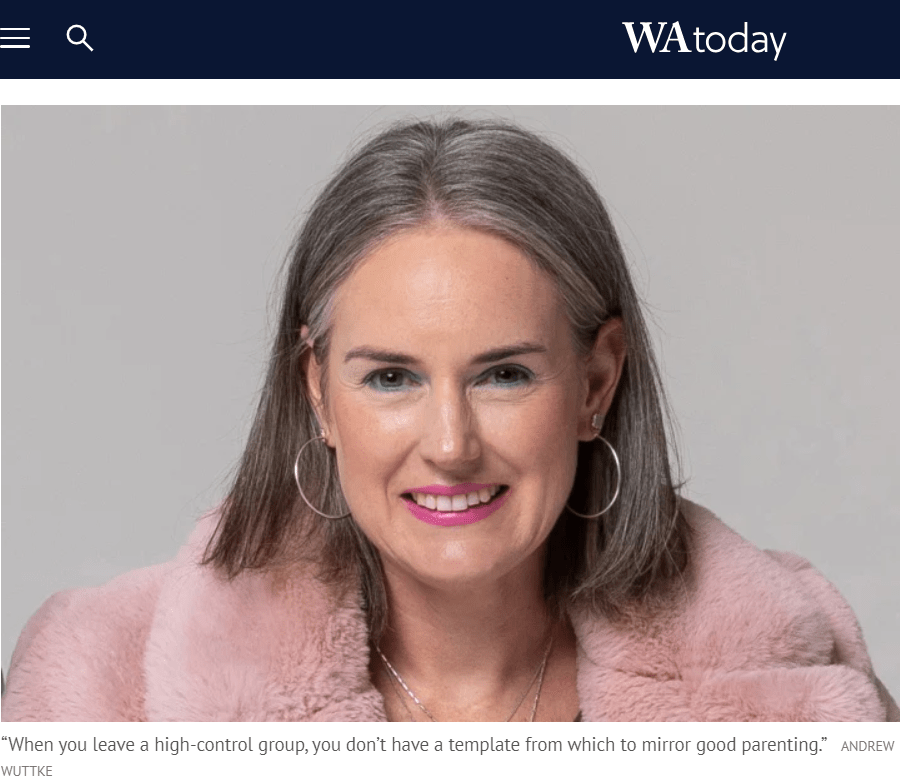
When you leave a high-control group, you don’t have a template from which to mirror good parenting. You’re relearning to do things in a very different way and, as a result, I find parenting to be a lonely experience.
And due to the abuses I experienced, I’m hyper-vigilant. This means my son hears and learns about personal safety and consent at a much younger age than most. In turn, during periods when I’m not feeling well, he understands that I can’t be completely present in his life.
I aim to raise a well-rounded human being, who can identify safe people, has the ability to be confident in life and is surrounded by good friends, so he won’t need to fill his voids from such groups.”
“The backlash from the parish was shocking” Mel Welch, 41, was born and raised under strict religious doctrine. When she left the church, she was overprotective of her children. She has since learnt that instilling self-trust is the best way to empower them.
“There were lots of rules and heavy control under the religious group I was raised in. The biggest fear instilled in me was of going to hell. It was deeply ingrained that if I upset anyone or did anything wrong, that would upset God and I would be banished to hell automatically. So I made sure not to upset the pastors or my parents.
I married a pastor’s son when I was 18 and he was 20. Marriage was the only way that being alone together would be allowed by the pastors.
Sadly, my first-born child died at birth. The backlash from the members of the parish was shocking: some said my baby’s death was because we didn’t pray enough. We were consequently given six weeks to get over our grief.
I went on to have four more children and by the time I turned 30, I could no longer keep up with the pressure I was putting on myself to attend weekly church gatherings and Sunday service. Feeling that no matter what I did I would never be enough, one Sunday afternoon in 2012 I sat opposite my husband and said, ‘I’m no longer attending church.’ My body felt nauseous from the anxiety of even hearing me say that and my husband turned white. That goes to show just how much power they had over our lives.
Consequently, I was shunned by the community. Gradually, my husband came to his own realisation and conclusion about the church and followed me six months later.
During this time, I continued to read the Bible on my own. The more I did, the more I started to listen to and trust my intuition about what the teachings meant. This is a new God, I realised. I slowly understood that I wasn’t going to die because I’d left the church. It was all a lie, so I started to wonder what else wasn’t true.
There was definitely a long transition period around figuring out how to raise my kids, because I was relearning so much and essentially becoming an adult myself. Until I was able to discern the lies from the truths, I became overprotective of them, a form of helicopter parenting, especially around any sort of religious ideas or strict ideals.
Over time, I realised that self-trust is necessary to thrive. I’ve taught my children to create a personal relationship with God through reading the Bible on their own, a relationship that’s based on self-awareness and confidence in their own instincts.”
“Marrying outside the church was frowned upon” Susannah Birch, 37, was raised in a church that discouraged her from engaging in “worldly” activities. She is teaching her children how to be independent thinkers.
“One of the main teachings I was raised on is that Christians shouldn’t be ‘worldly’. This meant I wasn’t allowed to read mainstream books – by the time I was 12, I had actually read the Bible twice – watch popular movies or wear ostentatious jewellery or make-up. Sex before marriage was considered a sin. Further, being friends with or marrying anyone from outside the church group was severely frowned upon because they were considered to be ‘evil’.
My parents divorced when I was 13, by which time my family had distanced itself from the church. To my surprise, my father, who maintained more balanced religious beliefs, allowed me to do things considered worldly. I quickly discovered the Spice Girls and Buffy the Vampire Slayer, and that began to change my whole world view. I also read different book genres and that made me question everything I had been taught growing up.
Subsequently, at age 20, I married a non-Christian. And when I had my two children, I intentionally introduced them early on to a wide range of fiction, music and movies so they could have a holistic view of the world.
Prior to becoming a parent, I thought I was over my indoctrination. Yet whenever my children did things the church would consider wrong or ‘sinful’, I was back in that world. I had to take conscious steps to prevent myself from imposing narrow ideas on my children. Today, whenever my children do something wrong, I try to explain to them why it’s wrong, as opposed to the punishments I received growing up, which I was never allowed to question.
My children attend a Catholic school, which I chose due to the quality of education it offers. It doesn’t bother me that they may be exposed to religious teachings, because at home we read and talk about multiple religions and philosophies, including paganism and Buddhism.
I’ve done my best to teach them to see different points of view and choose what they want to follow, after applying critical thinking. If they feel that something is true simply from emotions or peer pressure, I try to encourage them to question why and to think for themselves, not to be swayed by others’ opinions. I also want them to question the world around them and not to sit in self-criticism, as the church I grew up in taught me to do.”
It’s so easy to be judgy about people who get caught up in a cult, right? Even if you don’t want to be. I mean, it wouldn’t happen to us. We’d see right through all that weird stuff – like the specific language that means nothing to outsiders, knowing that only believers are on the right path, the rules which make no sense, and the charismatic leader who is clearly a bit off.
That’s what I thought when I started digging around, researching my latest novel that looks behind the walls of The Sanctuary, an imagined closed religious community dedicated to clean, organic living and environmentalism.
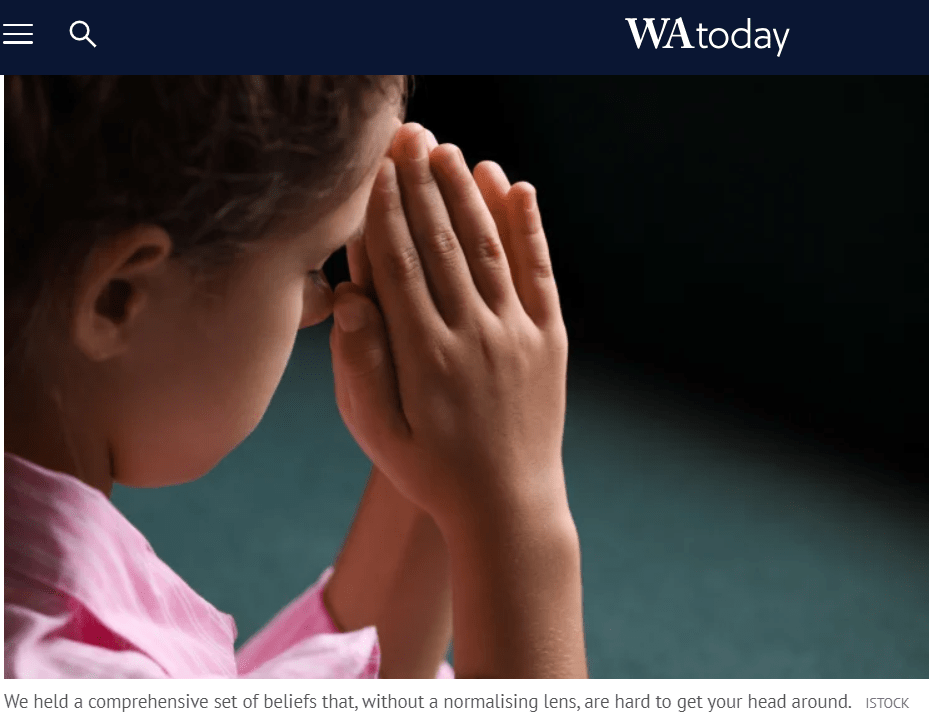
While there may be no single definition of a cult, they share a few potent ingredients, such as general isolation from the rest of society, an unquestioning adherence to a set of beliefs, a strict authoritarian hierarchy of power and a rock-hard sense of being among the chosen ones.Hmmm. I recognised quite a few of those ingredients. I hadn’t joined a cult. But maybe I’d been born into one.I grew up in a large Catholic family on an isolated farm outside Melbourne. I went to a Catholic school, we went to Mass on Sunday, we socialised with other Catholics. We basically didn’t mix with anybody else. We did know one or two non-Catholics and they were nice but they weren’t going to heaven. Not like us.We held a comprehensive set of beliefs that, without a normalising lens, are hard to get your head around. Such as Mary’s virgin birth, eating Christ’s body and drinking his blood, going to hell if you missed Mass on Sunday. We even had a shared language that defined us, such as transubstantiation (bread and wine in the Eucharist becomes Christ’s real body and blood) and the Blessed Trinity (three Gods in one, but really it’s just one God).
We held a comprehensive set of beliefs that, without a normalising lens, are hard to get your head around. Such as Mary’s virgin birth.
Then there were the rules about when you ate and what you ate, such as no eating before Mass, and no meat on Fridays, which I loved because we got to have fish and chips once a week – religiously. You had to regularly confess your sins, which led to considerable pre-reconciliation whispering as us kids figured out which sin we could make up this week.
And most damagingly, there was the unquestioned power of the god-like parish priest. And we all know now what that resulted in. In fact, the 2017 Royal Commission into Institutional Responses to Child Sexual Abuse inquiry identified my parish and the local boy’s secondary college as one of the active centres of paedophilia.
I didn’t question any of these rules and beliefs.
The contest of ideas I discovered at university knocked our brand of Catholicism out of me. Yet, still, years later when I had my own family, the kids eventually did some of the sacraments so they wouldn’t feel too out of place at family church events.
When my youngest child was preparing for their First Reconciliation, we dutifully read the children’s Bible stories from the Old Testament every night as requested. Now this child, who had previously declared that they wanted to be an “evil overlord” when they grew up said to me one night, “Oh mama, I’m getting a lot of good ideas about how to be an evil overlord from God.”
I laughed out loud. I hadn’t seen it before. I had completely normalised that God could legitimately require Abraham to prove his undying devotion by killing his son. Or that it was perfectly acceptable that God would test Job’s excellent piety by taking away his possessions, his family and then his health. Yeah, now that I think about it, my child was spot on: you could say that the God of the Old Testament did abuse his power as leader.
Obviously, it was a unique set of conditions that meant I experienced cult-like conditions as a child. Very few people can now live in that kind of isolation. We have the internet, which beams in all sorts of ideas all the time. As well, the modern Catholic Church has shared leadership between priests and parishioners, so authority no longer rests in a single godlike being.
There are thousands of cults across the world, from self-help cults, to political and religious cults. Many of them don’t look anything like the doomsday cult, Heaven’s Gate, which ended in mass suicide, as members tried to catch a passing comet in 1997. Or Australia’s own Ideal Human Environment, which began in the ’80s as an experiment in happiness, harmony and ideal living. In 2019, leader James Salerno was imprisoned for unlawful sexual intercourse with a child, and the truth about the abuse behind those closed doors was exposed. The IHE had been operating for 30 years.
None of us joins a cult – we join a movement to make ourselves and the world a better place. But my experience taught me that it’s a fine line between intentional community and cult. That line is defined by how power is exercised.
So, whether you’re seeking your own happiness, or a new way of making the world a better place, like that great meditation group you just joined or that conspiracy idea that is sweeping around you, take care. Watch what happens when you ask questions. If they close you down, or make you feel guilty for asking in the first place, I’m guessing it is a good idea to keep asking those questions.

 陳旭@perth