與此同時,Dayes 的老闆 World Fortunes 也在經營 Beauty Within 網站,這對 30 多歲的播客影響力人士在網站上推銷各種年輕女性護膚產品,這些產品通常與 World Fortunes 從韓國進口到 Middletown 地址的化妝品類似。Epoch 和 NTD 宣傳 Beauty Within 的內容,而主持人則宣傳法輪功。他們的YouTube帳戶有超過兩百萬的追隨者。
World Fortunes 的另一個專案是 Youlucky.biz,主要針對說中文的移民社群。付費訂閱者可以觀看大紀元 YouTube 系列節目 American Thought Leaders 的翻譯,其中包括 Grover Norquist 和 Christopher Rufo 等人的訪談。他們還可以在其 「Mall 」版塊中購買美容產品、服裝和電子產品。
DOJ Says Epoch Times Newspaper Is an Epic Money-Laundering Operation
Portrait of Matt Stieb By Matt Stieb, Intelligencer staff writer
One of the strangest stories in media over the past decade is the Epoch Times, a formerly free newspaper distributed on the streets of New York that focuses on conspiracist, right-wing takes and reports that are extremely critical of the Chinese Communist Party. Founded in 2000, it effectively functions as a propaganda wing of Falun Gong, the religious movement headquartered upstate that is also behind Shen Yun, the anti-communist show with the inescapable subway ads. During the Trump years, the Epoch Times successfully expanded its operation on YouTube and Facebook, reaching millions of Americans with clickbait and misinformation. According to the Justice Department, it also functioned as a massive money-laundering scheme for one of its executives.
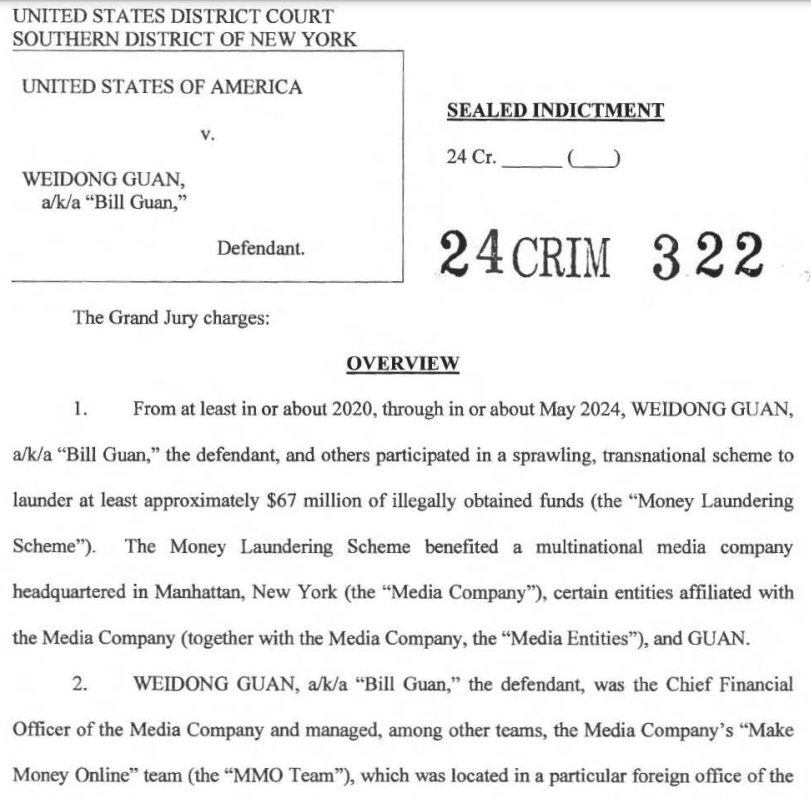
On Monday, federal prosecutors in New York charged the Epoch Times’ chief financial officer, Bill Guan, with bank fraud and conspiracy to commit money laundering for allegedly moving at least $67 million in illegally obtained funds to bank accounts in the media outlet’s name. According to the indictment, Guan was in charge of something (rather suspiciously) called the “Make Money Online” team, in which Guan and underlings “used cryptocurrency to knowingly purchase tens of millions of dollars in crime proceeds.” The alleged scheme was fairly simple, relying on prepaid debit cards, which are a common method in crypto laundering. The Make Money Online team, based abroad, would allegedly purchase “proceeds of fraudulently obtained unemployment insurance benefits” loaded onto prepaid cards. The team then allegedly traded them for cryptocurrency at 70 to 80 percent of the cards’ actual value. After making the deal, the Feds claim that those funds would then be transferred into bank accounts associated with the Epoch Times as well as into Guan’s personal bank accounts.
It appears that the Make Money Online team lived up to its name. The Feds say that at the same time that Guan allegedly concocted the money-laundering scheme, the Epoch Times’ annual revenue shot up 410 percent, from $15 million to around $62 million. Its bankers naturally had questions, but Guan said that the windfall came from donations, per the indictment. (Unfortunately for him, he also wrote to a congressional office in 2022, stating that donations are “an insignificant portion of the overall revenue” of the Epoch Times.) Guan has entered a not guilty plea, and prosecutors note that the “charges do not relate to the Media Company’s newsgathering activities.”
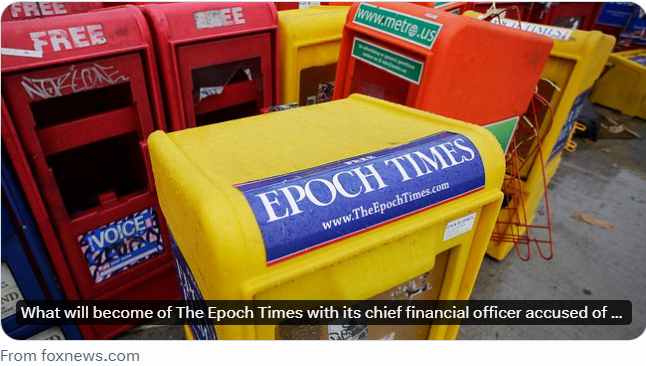
What will become of The Epoch Times with its chief financial officer accused of money laundering?
Weidong “Bill” Guan, the chief financial officer of The Epoch Times, has been charged with steering $67 million in criminal proceeds to the media outlet, its affiliates and himself.
Guan has pleaded not guilty but was suspended by the media company.
The Epoch Times, founded in 2000, is a newspaper that is available in 23 languages. The arrest of an executive at The Epoch Times in a money-laundering scheme this week has drawn attention to a media outlet that has lived largely in the shadows since its founding in 2000 and a transformation during the Trump administration.
Federal prosecutors in New York charged Weidong “Bill” Guan of Secaucus, N.J., chief financial officer of The Epoch Times, of steering at least $67 million in criminal proceeds, much from fraudulently obtained unemployment insurance benefits, to the company, its affiliates and himself. Guan pleaded not guilty but was suspended by The Epoch Times, which agreed to cooperate with prosecutors.
The case calls into question the future of a company that was a key online supporter of Trump and spreader of conspiracy theories.
WHAT IS THE EPOCH TIMES?
Started first as a newspaper, the company produces news websites and videos, and is now available in 23 languages. Its founder, John Tang, is a Chinese-American who practices Falun Gong, a form of meditation and exercise. The Chinese government has denounced, banned and, according to members, has consistently oppressed and mistreated Falun Gong followers.
While the outlet has sought to distance its operations from the Falun Gong movement itself, the company has said it “sees the Chinese Communist Party’s persecution of Falun Gong practitioners, and the remarkably heroic ways in which practitioners have responded to the persecution, as one of the most underreported stories of the last 20 years.”
It is by no means a one-issue news organization, and the lead story on its website Wednesday was about U.S. political primaries the night before. But The Epoch Times does frequent and tough reporting on the Chinese government; stories on its website Wednesday included an opinion piece on the origins of the COVID virus and a look back at the Tiananmen Square massacre on its 35th anniversary. The site also prominently touts a book by Falun Gong founder Li Hongzhi.
The Epoch Times says that “our aim is not to force our perspective on you, but to give you the information you need to make up your own mind.”
HOW DID THE EPOCH TIMES CHANGE?
The Epoch Times website currently has testimonials from Trump administration figures Peter Navarro and Sebastian Gorka and U.S. Rep. Paul Gosar, a Republican from Arizona.
That’s a clue. The news organization transformed itself during the Trump years by becoming a site that the supported the former president and his causes. It was opportunistic in two ways: leaders saw in Trump a president they believed would fight against the Chinese government, and sensed the chance to win funding from others who believe in the cause, said A.J. Bauer, a University of Alabama professor who studies conservative media.
In a few years’ time, the outlet became a partisan powerhouse and “has also created a global-scale misinformation machine that has repeatedly pushed fringe narratives into the mainstream,” The New York Times reported in 2020.
It embraced various conspiracy theories, many surrounding COVID. The Epoch Times and affiliates advanced the false story that the Obama administration spied on Trump’s 2016 campaign and spread theories promoted by the QAnon conspiracy site and claims about voter fraud.
The Epoch Times was particularly aggressive on Facebook through advertising and the creation of different pages that guided social media users to their content. Following an investigation by NBC News, the social media giant in 2019 banned pro-Trump advertisements produced by the outlet for violating its ad policies.
The indictment doesn’t specifically say that these pro-Trump efforts were funded through the alleged criminal scheme. But it was around this time that money was pouring in. The Epoch Times reported nearly $128 million in revenue for 2021, a stunning increase from $4 million in 2016, according to a federal financial disclosure. The turnaround caught the eye of banks, regulators and, eventually, federal prosecutors.
Much of the money came in through the company’s “Make Money Online” team, run by Guan, according to the federal indictment. Guan has claimed the windfall was due in part to an increase in subscriptions and donations, the indictment said.
WHAT DOES THIS MEAN FOR THE EPOCH TIMES’ FUTURE?
Guan is the only one charged by prosecutors. But the indictment states that “others known and unknown” were aware of what was going on, raising questions about whether anyone else at the company might be drawn in and what this might mean for The Epoch Times’ future. The company didn’t immediately respond to a query on the topic.
Given the action taken against the company by Facebook in 2019, it’s questionable whether the playbook used before has relevance for the 2024 campaign. Some avenues for reaching people have undoubtedly closed because the social media site has been deemphasizing news and political content, Bauer said.
Conservative figures certainly noticed the work put in by The Epoch Times on behalf of their causes. Despite that, the outlet has had surprisingly little influence, said Howard Polskin, who monitors conservative media for The Righting website.
“They don’t seem to be driving the news agenda in right wing media,” Polskin said. “I don’t think right-wing media is paying much attention to what they are doing.”
Bauer agreed. The Epoch Times’ influence seems largely confined to people for whom opposing the Chinese government is a main cause, he said.
“They’re having a hard time, just like everybody else in the media, in finding an audience at this moment,” Bauer said. “I don’t think there’s too many people calling up The Epoch Times on their computer with their morning coffee to see what they have to say.”
据该邮件,越南语团队被要求帮助大纪元(Epoch Media Group)在Facebook上建立自己的帝国。大纪元是负责法轮功在美国最大媒体资产的综合机构。那年,Facebook上出现了几十个新页面,全都有到《大纪元时报》及其附属出版物的链接。有些带有明显的党派色彩,有些把自己定位为真实无偏见新闻的来源,还有几个完全与新闻无关,比如一个名为“最有趣的家庭时刻”(Funniest Family Moments)的幽默页面。
时报获得的电子邮件显示,曾长期担任《大纪元时报》主编的约翰·纳尼亚(John Nania)与法轮功下属的广播网络“希望之声”(Sound of Hope)的高管们一起参与了《美国日报》的创办。Facebook上的记录显示,该页面由“希望之声”网络运营,其Facebook页面上的一篇永久置顶的帖子里是法轮功的宣传视频。
斯坦福互联网观察站(Stanford Internet Observatory)研究虚假信息的研究员雷妮·迪瑞斯塔(Renee DiResta)说,有些页面“似乎一夜之间”就获得了大量关注。许多帖子被分享数千次,但几乎没有收到任何评论——迪瑞斯塔说,这种比例对由“点击农场”推动的页面来说很典型,“点击农场”指的是通过付钱让人们一次又一次点击某些链接来产生虚假流量的公司。
From stores to Kevin Sorbo, the sect runs a quiet business empire, and it’s centered upstate.
By William Bredderman, an investigative journalist covering covert influence and corruption
hen Diana, the second-floor clerk at the New Middletown shopping center, hears I’m visiting from the city, she insists I see Shen Yun at Lincoln Center.
“It’s traditional Chinese culture,” she tells me. “No communism!”
Shen Yun, of course, is the traveling agitprop dance troupe controlled by Falun Gong, a religious movement born in China in the early 1990s that today has its headquarters at a 400-acre estate in the woods of upstate New York. Two other well-known mouthpieces of the movement are The Epoch Times newspaper and its television affiliate, New Tang Dynasty, or NTD, notorious trumpets of right-wing disinformation. Both outlets made news in June when Epoch CFO Weidong “Bill” Guan was indicted for allegedly running a $67 million money-laundering scheme and the media conglomerate’s founder, Zhong “John” Tang, subsequently resigned.
But for all the noise Epoch has made lately, much of Falun Gong’s business operates silently, like this bright, glossy shopping center on a weekday afternoon. Shelves of Falun Gong literature bank the stairhead, and the rest of the store, laid out like a flea market, offers a panoply of imported foods and kitchenware products — most from East Asia — as well as jewelry, stationery, accessories, and apparel.
Located 20 minutes east of the main Falun Gong compound, Middletown is experiencing a slow-motion annexation by the sect. Through its various arms, it has acquired over $18 million in real estate in this working-class town of 30,000 residents — not counting the many more properties its adherents and their companies have purchased in recent years. As with many things here, peel back the veneer and you’ll find Guan, Tang, and the Epoch media operation behind them. Shen Yun Collections acquired the shopping center last year from Universal Communications Network, the company through which the two men ran NTD.
Next to the New Middletown checkout counter are promotions for Gan Jing World, a “clean content” app that lifts videos from YouTube and splices them with NTD, Epoch, and Shen Yun content. Gan Jing World’s headquarters is a squat four-story office building a five-minute walk from the store, facing a fossilized factory plastered with chiropractor ads. One of the start-up’s vice-presidents moved to Middletown from San Francisco, where she had worked as president of Epoch’s branch there. Earlier this year, Gan Jing World assured an inquiring reporter from Columbia Journalism Review that the company is just “friends” with Epoch and not formally affiliated. Yet an executive from Epoch’s Texas office helpfully undercut this claim by filing incorporation paperwork for the “Falun Dafa Gan Jing World Foundation” at the app’s new Middletown digs in 2023. That entity, in turn, bought two adjacent properties from Universal Communications: a storage facility that today provides extra parking to the app’s employees, and a defunct Honda dealership that’s now a soundstage called GJW Studios.
Meanwhile, across the street from the New Middletown center is Dayes Coffee Roasters, which is undergoing renovations and slated to reopen soon. The windows may be papered over, but it’s easy to peer through the façade. Trademark records show Dayes belongs to a firm called World Fortunes Inc., which Guan and Tang founded in 2015. (World Fortunes also, until recently, operated an auto-repair shop in Middletown’s south end.) The Epoch Times extols the brand’s “enzyme-fermented” brew, which is supposedly free from the toxic mold that festers in regular coffee.
Dayes’ website boasts a roastery on the town’s western fringe, on a stretch of scabby road populated mostly by aluminum-sided Cape Cods. Universal Communications owns this location, too. The gleaming café space wasn’t operational yet, but a man sat in an adjoining garage amid packing detritus and chrome roasting equipment. He pointed me up a hill, advising I would find an open Dayes shop in a former psychiatric center the city sold in 2017 to Falun Gong’s Fei Tian College, which last fall turned it over to a nonprofit controlled by Tang and Guan.
The cluster of brick buildings in various stages of rehabilitation reflects the extent to which Epoch has insinuated itself into the community. Under the leadership of Mayor Joseph DeStefano, Middletown continues to buy abandoned structures at the former sanitarium from the state and transfer them to Falun Gong–linked entities. The city also sold off a former community center in 2021 that now serves as the recording studio of the Epoch-affiliated Sound of Hope radio network.
DeStefano told me all deals had gone through a formal public-approval process.
“They’re spending millions and millions of dollars renovating buildings that were abandoned by the State of New York and that nobody else was interested in, I might add,” the mayor said. “I’ve never dealt with a more straightforward and honest group of people in my life.”
Sadly, the Dayes café on campus was empty except for one guy painting the ceiling. “We open tomorrow,” he said.
No matter, though: Dayes beans are available online — and online is where the greater part of Epoch’s dominion lies. Dayes, for instance, is sold on a site called BestGift.com, which is controlled by yet another Tang-founded company based in the Epoch offices. BestGift calls itself “an official retail partner of The Epoch Times” and offers discounts to the paper’s paying subscribers. The target market is evident in the lead image on the site: a group of white senior citizens toasting with white wine outdoors. Besides java, it hawks garden products, decorative mailboxes, soaps, and joint-pain supplements.
Meanwhile, World Fortunes, the owner of Dayes, also operates Beauty Within, a website on which a pair of 30-something podcaster-influencers push various skin-care products for young women — ones often similar to cosmetics that shipping manifests show World Fortunes has imported from South Korea to a Middletown address. Epoch and NTD promote Beauty Within content, while the hosts promote Falun Gong. Their YouTube account has over 2 million followers.
Another World Fortunes project is Youlucky.biz, which is aimed at the Chinese-speaking diaspora. Paying subscribers can watch translations of Epoch’s YouTube series American Thought Leaders, featuring interviews with the likes of Grover Norquist and Christopher Rufo. They can also shop its “Mall” section for beauty products, clothing, and electronics.
Gan Jing World, meanwhile, offers not just the app content but a subscription service called GJW+, which streams low-budget-looking animated programming and documentaries, and a Gan Jing Campus product that provides Falun-flavored educational videos.
Even more ambitious is one of the last ventures Guan launched before his arrest: Epoch Studios’ first feature-length film, starring Cuba Gooding Jr. and conservative favorite Kevin Sorbo (a.k.a. Hercules, if you grew up in the 1990s). Called The Firing Squad, it is loosely based on Indonesia’s 2015 execution of a group of drug traffickers, some of whom had converted to Evangelical Christianity. “I found Christ in here,” Sorbo’s character relates over the trailer’s stirring strings. “I found Christ too,” rasps Gooding.
The trailer boasts that the film has the same marketing team as The Passion of the Christ and Sound of Freedom, and its website has adopted the latter’s strategy of urging supporters to buy out multiple seats or even whole theaters in a campaign to “bring one million souls to Jesus.” The flick hit screens, including two movie houses in Middletown, on August 2.
The question, of course, is why: Why all the side hustles, why take over an upstate town?
A former Epoch Times staffer who requested anonymity recalled the business struggling when they worked there a decade ago. Reporters labored for paltry salaries at Ikea desks they assembled themselves, and they depended in part on meals a Falun Gong practitioner cooked for them at the office. Epoch toggled through consecutive unsuccessful business models — free content with ads, paywalls, print delivery — and survived on donations from wealthy believers. “It has all the problems other companies face in digital,” the former staffer said, suggesting that all the ancillary companies represent efforts to find additional revenue.
Epoch simply might have arrived at the same conclusion as other 21st-century publications: The news business just isn’t business enough, and a media venture must become a lifestyle brand for its consumers. Seen this way, Middletown — where your shopping and coffee and education and entertainment and even, till recently, your oil change can send money back to Falun Gong and its media affiliates — begins to look like the Epoch empire in microcosm.
There are means of taking in cash besides operating a profitable enterprise, however, and having numerous corporate faces can prove useful for this, too. For instance, The Firing Squad website urges supporters to invest in the movie — and to mail checks to a Guan company located in Epoch’s offices. This has reaped more than $2 million to date.
That’s a pittance compared to the $46 million and counting in federal grants and loans that Epoch, Shen Yun, Falun Gong, and assorted subsidiaries obtained during the pandemic. Further, federal prosecutors in the money-laundering case against Guan allege he had “fraudulently procured unemployment insurance benefits obtained using stolen personal identification information” via various “media entities.” Epoch, Guan’s attorney, and Tang did not respond to requests for comment.
Working behind various corporate curtains also grants a degree of secrecy. A woman walking her dog in the park, the elderly couple I accosted en route to dinner, the bartender at the local brewpub (every Hudson Valley town has one) all told me they hadn’t noticed much that had changed around town except the Chinese names appearing over local businesses and some additional Asian Americans on the streets.
“Everything honestly seems like the same,” Meghan, the woman with the dog, told me.
Ignorance was also Mayor DeStefano’s plea. Enjoying regular friendly coverage and his own tag on Epoch’s website, the long-reigning Democrat cut the ribbon at the opening of the New Middletown center, appeared at multipleGan Jing World events, and has issued repeated proclamations for “World Falun Dafa Day” — even praising the sect’s work toward a “peaceful, tolerant, more compassionate society.”
Through Election Day, the campaign headquarters of the Orange County Democratic Party will be housed in a freshly renovated property opposite the shopping center, owned by a Flushing-based Falun Gong activist who has repeatedly appeared in TheEpoch Times. The refreshed façade is owed to a $25,000 city-administered loan to the new owner that DeStefano signed off on in 2019.
DeStefano, the former party chair, admitted to helping arrange the lease but said he had shown his fellow Democrats several locations and underscored the official protocols the loan went through.
He denied knowing that the property owner is linked to the movement — in fact, he denied knowing that many of the new investors in Middletown are involved in Epoch and Falun Gong. He also denied any awareness of Falun Gong’s founder having denounced homosexuality as “filthy” and “repulsive” or of the cult’s history of alleged racial discrimination. He added that he had never met Tang or Guan, even though companies the two created control growing swaths of his city.
What matters, DeStephano argued, is that new residents and “several millions of dollars” are pouring in and that down-in-the-mouth brick storefronts are getting fixed and filled. He said he’d never had any interest in tracing Epoch’s web, even as it entangled his town. “I don’t do a background check on people we’re dealing with,” he said. “That’s none of my business.”


 陳旭@perth