Exclusive: Report from Independent Schools Australia calls for data collection on student school refusal to better tackle rising absenteeism
A new report has urged the federal government to collect national data on chronic absenteeism and embed layers of support in schools to tackle Australia’s growing student attendance crisis.
The report, provided exclusively to Guardian Australia by Independent Schools Australia (ISA), drew from interviews with academics, mental health clinicians and teachers. It called on the government to implement a multi-tiered system of support (MTSS) to better support children struggling to stay in school.
The approach would allow schools to begin systematically categorising and collecting national data on the reasons for non-attendance.
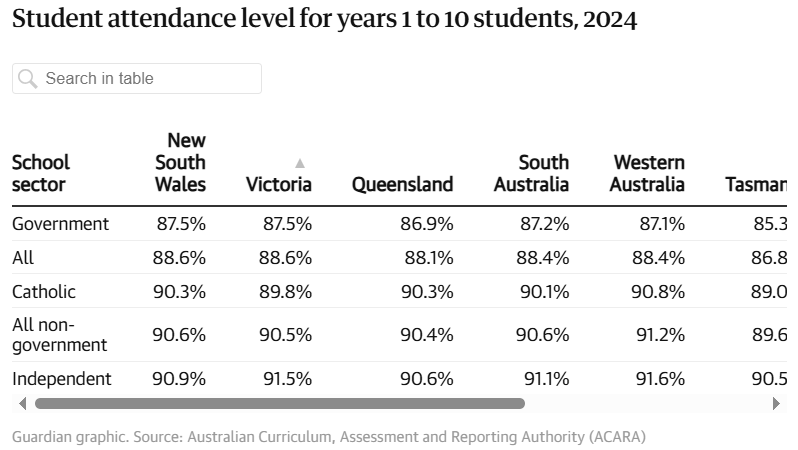
More than 40% of students in years 1 to 10 were missing at least one out of 10 school days, the latest Australian Curriculum Assessment And Reporting Authority data showed.
That rate had steadily worsened over the past five years. In 2019, 73.1% of students were attending at least 90% of school days. In 2024, the figure was just 59.8%, down from 61.6% in 2023.
Attendance also declined by socio-educational advantage and were lower for remote students and Aboriginal and Torres Strait Islander students. Just 35.2% of First Nations studentshad attendance levels at or above 90% in 2024, compared with about 49% before the pandemic.
The chief executive of ISA, Graham Catt, said there was no national consistency in how non-attendance was defined, recorded or addressed.
“Our new report highlights the need to differentiate types of absenteeism … and calls on the Australian government to lead a cross-sector pilot to test it,” he said.
The report found the term “school refusal” was “misleading” as it suggested a choice, pointing to complex barriers like anxiety, trauma and illness that prevented attendance.
It suggested school refusal often peaked at ages five to six and 10 to 11, during transitions like starting primary or high school or moving schools.
Mainstream schooling may also not be working for young people with additional needs. The report found there had been a 276% increase in enrolments at independent special assistance schools since 2016.
“Absentee recording systems can capture the level of non-attendance but are not nuanced enough to understand the reasons for it,” the report read.
“Schools need to differentiate school refusal from other forms of absenteeism … without a nationally consistent definition … accurate data cannot be collected, and it is difficult for schools to determine when intervention strategies may be required.”
The report said a MTSS model could be implemented to monitor attendance – from occasional absences to chronic disengagement —and help schools respond accordingly. The idea has also been backed by the Australian Education Research Organisation (Aero) after being commissioned by the government to investigate the issue.
Tiered interventions would range from initial whole-school strategies to address wellbeing and belonging, like peer support and anti-bullying programs, to early support interventions for students showing signs of distress and intensive wraparound support for students with complex needs.
For instance, students at a Tier 2 could be offered hybrid attendance or have safe spaces at the school for when they were feeling overwhelmed, while students at Tier 3 may be offered a specialised school support team and external health services.
A Senate inquiry into the issue, initiated by the Greens, released a report in 2023 that recommended a string of measures, including improved access to mental health care and more funding to parent support groups to address the “alarming rate” of absenteeism.
The Senate reportnoted efforts to tackle school refusal had been hindered by the absence of a nationally consistent and coordinated approach, including a lack of agreed methodology for collecting and reporting on data on chronic absenteeism.
The federal government agreed or supported in principle just two of its 14 proposals, including tasking the Australian Education Research Organisation (Aero) with analysing school refusal and working with governments to embed school refusal training in teaching courses.
Last year, the federal government came under fire from the Greens, peak bodies and experts for refusing to implement the recommendations from the Senate reportto front a national action plan or offer peer support funding to reverse the national trend of school refusal.
A founding board member of School Can’t Australia, Tiffany Westphal, said MTSS was “not the solution in and of itself” and may yield “too little support, too late”.
“Instead of focusing on absence we need to tune into signs of distress which are frequently apparent prior to impacts on attendance,” she said.
But Catt said as it stood schools were being asked to solve the issue “without consistent tools or definitions”.
“We need to rise above politics and blame to do better for students, families, and schools across Australia,” he said.
特恩布爾一直在削弱阿博特的領導力,他利用阿博特滿意度的下降以及聯盟在 Newspoll 的兩黨傾向評分上低於 ALP 的情況。特恩布爾在失去阿博特在2013年贏得的所有席位後贏得了2016年的選舉,在2015年11月至2016年3月期間,他的滿意度下降了21個百分點,並在2016年7月至10月期間繼續失去11個百分點。
在 Newspoll 調查中,Turnbull 較 Abbott 落後的時間更長,因此在 Scott Morrison 贏得的挑戰中,Turnbull 被撤換為領袖。
For his first 2½ years as Prime Minister, Anthony Albanese has avoided something that befell all his predecessors, Labor and Liberal alike, in the past three decades: a sudden, catastrophic fall of personal support in Newspoll.
Every prime minister since John Howard’s election in 1996 has had a sudden fall in Newspoll’s satisfaction ratings of between eight and 24 percentage points after breaking a major promise, a failure of leadership or a loss of public faith after a bad decision.
Albanese has suffered a decline in satisfaction – falling 10 points over an eight-month period to Monday’s first Newspoll of the year – but it has been more of a gradual decline without the short, sharp jolt of a catastrophic fall that all his predecessors had suffered.
Only Howard survived such a catastrophic collapse in popular support as prime minister to lead the government to the next election and win.
Howard’s catastrophic fall in support by 14 percentage points in just six weeks was a result of his decision to adopt a GST at the next election – 1998 – after pledging to “never ever” introduce a goods and services tax.
He kept the Liberal leadership through to the election, which he won after a massive loss of seats and a slashing of the Coalition’s huge majority. Howard remained prime minister after the election and went on to become Australia’s second-longest-serving prime minister.
He is the only PM to survive then go on to prosper after a catastrophic loss of personal support.
Rudd and Abbott were replaced by their colleagues after failing on climate change and immigration and breaking budget promises and appointing Prince Phillip as a knight in the Australia Day honours list, respectively.
Gillard won the 2010 election after replacing Rudd but then suffered a catastrophic loss of support – 11 points – when she broke her election promise to never lead a government that had a carbon tax.
The Labor government never recovered and Rudd replaced Gillard as Labor leader and prime minister shortly before losing the 2013 election.
Although Abbott won with a sweeping majority at the 2013 election, his personal support suffered two big hits when he broke election promises not to cut health and education and then when he surprised even his own colleagues by making Prince Philip a knight.
Turnbull, who had been undermining Abbott’s leadership, used the fall in Abbott’s satisfaction and the Coalition’s fall below the ALP on two-party preferred ratings in Newspoll. Turnbull won the 2016 election after losing all but one of the seats Abbott won in 2013 after he had suffered a 21-point fall in satisfaction between November 2015 and March 2016 and went on lose 11 points between July and October 2016.
After falling behind in Newspoll surveys for longer than Abbott had, Turnbull was removed as leader in a challenge that was won by Scott Morrison.
Morrison scored a surprise election win in 2019 but then has a catastrophic loss of support – eight points – after being criticised for being absent during the 2019-20 bushfires and then another round of losses after the attacks on the government over the Brittany Higgins rape allegations.
In 2022, Morrison lost to Albanese who, as opposition leader, had targeted Morrison as prime minister over the bushfires and the Higgins furore.
Dennis Shanahan has been The Australian’s Canberra Bureau Chief, then Political Editor and now National Editor based in the Federal Parliamentary Press Gallery since 1989 covering every Budget, election and prime minister since then. He has been in journalism since 1971 and has a master’s Degree in Journalism from Columbia University, New York.
Prime Minister Anthony Albanese and Opposition Leader Peter Dutton have delivered their annual Australia Day speeches, highlighting differing visions of the nation.
Prime Minister Anthony Albanese and Opposition Leader Peter Dutton have shown differing views of the nation as the political leaders gave their annual Australia Day addresses.
Both leaders commemorated the day’s significance, but their addresses diverged sharply in tone and messaging.
Speaking in Canberra on Australia Day, Mr Albanese emphasised the need to “reflect, respect and celebrate”.
Meanwhile, Mr Dutton gave an address to his local community at the Dickson Australia Day citizenship ceremony where he celebrated “the best country in the world”.
“Happy Australia Day to all throughout this amazing country,” Mr Albanese said on the shores of Lake Burley Griffin.
“It’s inspiring to be able to, as it says, to reflect, but also to celebrate everything that we have created as a country.
“A great multicultural nation, where we respect people regardless of where they come from, regardless of their faith, their gender. Our diversity is, of course, a strength.”
Mr Albanese, who has made national reconciliation part of his political agenda, acknowledged the ongoing struggles of Indigenous Australians.
“We shared this continent with the oldest continuous culture on earth. And earlier this morning, myself and the Governor-General met with Ngunnawal Elders.
“It was a very important, respective ceremony. And here, we acknowledge the fullness and richness of our history.”
When questioned about the ongoing debates surrounding Australia Day on January 26, he expressed the need for unity but did not acknowledge the date itself.
“What unites us as Australians is our common commitment, whether we are a part of the oldest continuous living culture on Earth, or whether we’re people who are becoming citizens today.
“We all share that vision as Australians of a fair country, a country in which people can fulfil their opportunity, make a better life than themselves and their families.”
Dutton’s focus on national pride and heritage
In contrast, the Opposition Leader’s address focused on national pride, British heritage, and the success of migrants.
Mr Dutton marked the occasion by praising the decision to become Australian citizens, particularly focusing on the sacrifices made by earlier generations.
He highlighted the post-World War II migration wave as a key contributor to the country’s prosperity.
“We do live in the best country in the world and today is an opportunity to celebrate what that means. The values that people have fought for in uniform, and given their lives up for,” he said.
“I just think if you’ve been here and you can trace your family tree back 60,000 years, or your Australian family tree just goes back to the 1850s – which is the case for my family – or if you’re sworn in today, we are equal Australians.”
Mr Dutton called to celebrate “the best country in the world” but to do so “respectfully about our Indigenous culture but also of our British heritage”.
He painted a picture of immigrants arriving with little, yet forging successful futures.
“People who came here with not a dollar in their pocket, and yet got an education or worked hard and educated their children,” he said.
“And now their subsequent generations are more Australian than anyone.”
Mr Dutton’s focus was squarely on unity through shared values and national pride.
Both leaders also paid tribute to the Australian of the Year recipient, Neale Daniher, who was recognised for his efforts to find a cure for MND.
“Neale’s struggle over more than a decade now with the terrible MND disease… has shown courage, has shown inspiration,” Mr Albanese said.
“I do want to say congratulations to Neale Daniher for his recognition as well. Neale is an inspiration to all Australians,” Mr Dutton said.
“What he has done, the philanthropic support that he’s done, even during the most difficult years of his life, should serve as a real inspiration to every Australian.”
Anthony Albanese is back in Western Australia for the second time in weeks, wooing voters with big-spending election pledges as the major parties hone in on the key battleground state.
The Prime Minister announced $350 million to widen the Kwinana Freeway if elected in a bid to ease congestion for commuters, with WA Labor promising to match the funding for a total of $700 million.
Opposition Leader Peter Dutton later said the coalition would match the pledge if it wins government.
Mr Albanese visited WA on Monday, returning to the state after he embarked on a whirlwind blitz earlier in January.
A Federal election must be held by May 17 and a new poll shows the Prime Minister’s approval ratings continue to slide.
The latest Newspoll revealed 53 per cent of voters thought the opposition would win at the election, in its own right or as a minority, compared to 47 per cent for Labor.
The Coalition has increased its lead on the Government on a two-party preferred basis to 51-49 per cent, a rise of one percentage point compared to the previous poll.
The Prime Minister said his Government was governing in the interests of all Australians and was building the nation’s future.
“There’ll be polls and the commentators will commentate on them, and certainly, what I understand is I don’t take election wins for granted,” he told reporters.
“We are working hard and fighting hard every day, not because it matters who drives the car with the flag on it, because what matters is what governments do for people and what they do for our country’s future.”
Labor will be eyeing off Moore, which is WA’s most hotly contested seat and held by the Liberal Party on a 0.9 per cent margin.
Moore MP Ian Goodenough lost a preselection contest for his federal seat and will run as an independent.
Mr Albanese pointed to the State as a future economic powerhouse.
“Western Australia will continue to be such a key role in driving national economic growth as one of the engine rooms of our national economy,” he said.
Mr Dutton is also in Western Australia as the coalition seeks to hang onto its seats, while trying win back the electorate of Curtin from independent MP Kate Chaney.
DOJ Says Epoch Times Newspaper Is an Epic Money-Laundering Operation
Portrait of Matt Stieb By Matt Stieb, Intelligencer staff writer
One of the strangest stories in media over the past decade is the Epoch Times, a formerly free newspaper distributed on the streets of New York that focuses on conspiracist, right-wing takes and reports that are extremely critical of the Chinese Communist Party. Founded in 2000, it effectively functions as a propaganda wing of Falun Gong, the religious movement headquartered upstate that is also behind Shen Yun, the anti-communist show with the inescapable subway ads. During the Trump years, the Epoch Times successfully expanded its operation on YouTube and Facebook, reaching millions of Americans with clickbait and misinformation. According to the Justice Department, it also functioned as a massive money-laundering scheme for one of its executives.
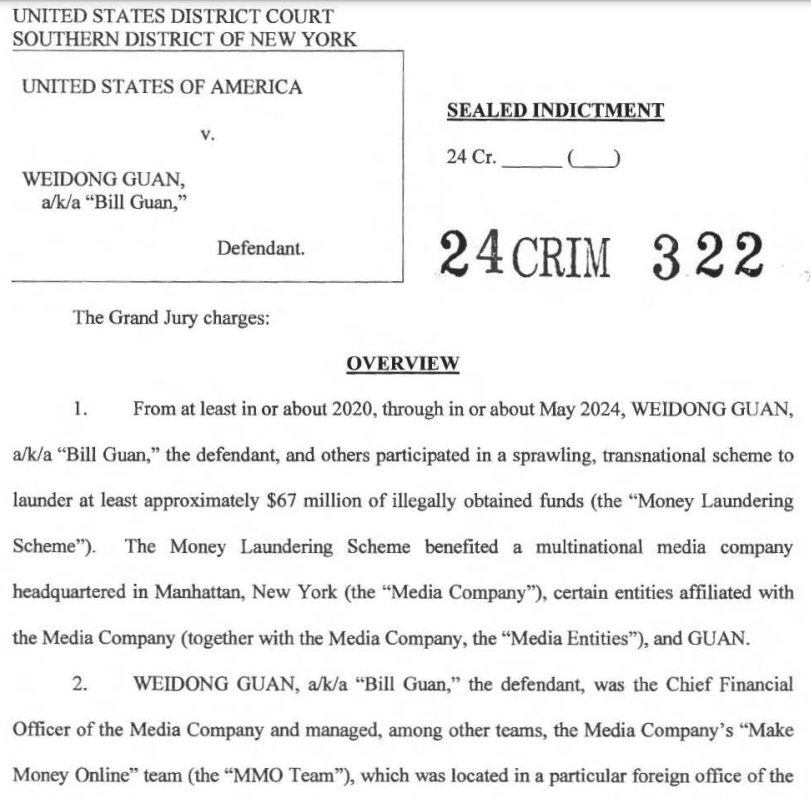
On Monday, federal prosecutors in New York charged the Epoch Times’ chief financial officer, Bill Guan, with bank fraud and conspiracy to commit money laundering for allegedly moving at least $67 million in illegally obtained funds to bank accounts in the media outlet’s name. According to the indictment, Guan was in charge of something (rather suspiciously) called the “Make Money Online” team, in which Guan and underlings “used cryptocurrency to knowingly purchase tens of millions of dollars in crime proceeds.” The alleged scheme was fairly simple, relying on prepaid debit cards, which are a common method in crypto laundering. The Make Money Online team, based abroad, would allegedly purchase “proceeds of fraudulently obtained unemployment insurance benefits” loaded onto prepaid cards. The team then allegedly traded them for cryptocurrency at 70 to 80 percent of the cards’ actual value. After making the deal, the Feds claim that those funds would then be transferred into bank accounts associated with the Epoch Times as well as into Guan’s personal bank accounts.
It appears that the Make Money Online team lived up to its name. The Feds say that at the same time that Guan allegedly concocted the money-laundering scheme, the Epoch Times’ annual revenue shot up 410 percent, from $15 million to around $62 million. Its bankers naturally had questions, but Guan said that the windfall came from donations, per the indictment. (Unfortunately for him, he also wrote to a congressional office in 2022, stating that donations are “an insignificant portion of the overall revenue” of the Epoch Times.) Guan has entered a not guilty plea, and prosecutors note that the “charges do not relate to the Media Company’s newsgathering activities.”
What will become of The Epoch Times with its chief financial officer accused of money laundering?
Weidong “Bill” Guan, the chief financial officer of The Epoch Times, has been charged with steering $67 million in criminal proceeds to the media outlet, its affiliates and himself.
Guan has pleaded not guilty but was suspended by the media company.
The Epoch Times, founded in 2000, is a newspaper that is available in 23 languages. The arrest of an executive at The Epoch Times in a money-laundering scheme this week has drawn attention to a media outlet that has lived largely in the shadows since its founding in 2000 and a transformation during the Trump administration.
Federal prosecutors in New York charged Weidong “Bill” Guan of Secaucus, N.J., chief financial officer of The Epoch Times, of steering at least $67 million in criminal proceeds, much from fraudulently obtained unemployment insurance benefits, to the company, its affiliates and himself. Guan pleaded not guilty but was suspended by The Epoch Times, which agreed to cooperate with prosecutors.
The case calls into question the future of a company that was a key online supporter of Trump and spreader of conspiracy theories.
WHAT IS THE EPOCH TIMES?
Started first as a newspaper, the company produces news websites and videos, and is now available in 23 languages. Its founder, John Tang, is a Chinese-American who practices Falun Gong, a form of meditation and exercise. The Chinese government has denounced, banned and, according to members, has consistently oppressed and mistreated Falun Gong followers.
While the outlet has sought to distance its operations from the Falun Gong movement itself, the company has said it “sees the Chinese Communist Party’s persecution of Falun Gong practitioners, and the remarkably heroic ways in which practitioners have responded to the persecution, as one of the most underreported stories of the last 20 years.”
It is by no means a one-issue news organization, and the lead story on its website Wednesday was about U.S. political primaries the night before. But The Epoch Times does frequent and tough reporting on the Chinese government; stories on its website Wednesday included an opinion piece on the origins of the COVID virus and a look back at the Tiananmen Square massacre on its 35th anniversary. The site also prominently touts a book by Falun Gong founder Li Hongzhi.
The Epoch Times says that “our aim is not to force our perspective on you, but to give you the information you need to make up your own mind.”
HOW DID THE EPOCH TIMES CHANGE?
The Epoch Times website currently has testimonials from Trump administration figures Peter Navarro and Sebastian Gorka and U.S. Rep. Paul Gosar, a Republican from Arizona.
That’s a clue. The news organization transformed itself during the Trump years by becoming a site that the supported the former president and his causes. It was opportunistic in two ways: leaders saw in Trump a president they believed would fight against the Chinese government, and sensed the chance to win funding from others who believe in the cause, said A.J. Bauer, a University of Alabama professor who studies conservative media.
In a few years’ time, the outlet became a partisan powerhouse and “has also created a global-scale misinformation machine that has repeatedly pushed fringe narratives into the mainstream,” The New York Times reported in 2020.
It embraced various conspiracy theories, many surrounding COVID. The Epoch Times and affiliates advanced the false story that the Obama administration spied on Trump’s 2016 campaign and spread theories promoted by the QAnon conspiracy site and claims about voter fraud.
The Epoch Times was particularly aggressive on Facebook through advertising and the creation of different pages that guided social media users to their content. Following an investigation by NBC News, the social media giant in 2019 banned pro-Trump advertisements produced by the outlet for violating its ad policies.
The indictment doesn’t specifically say that these pro-Trump efforts were funded through the alleged criminal scheme. But it was around this time that money was pouring in. The Epoch Times reported nearly $128 million in revenue for 2021, a stunning increase from $4 million in 2016, according to a federal financial disclosure. The turnaround caught the eye of banks, regulators and, eventually, federal prosecutors.
Much of the money came in through the company’s “Make Money Online” team, run by Guan, according to the federal indictment. Guan has claimed the windfall was due in part to an increase in subscriptions and donations, the indictment said.
WHAT DOES THIS MEAN FOR THE EPOCH TIMES’ FUTURE?
Guan is the only one charged by prosecutors. But the indictment states that “others known and unknown” were aware of what was going on, raising questions about whether anyone else at the company might be drawn in and what this might mean for The Epoch Times’ future. The company didn’t immediately respond to a query on the topic.
Given the action taken against the company by Facebook in 2019, it’s questionable whether the playbook used before has relevance for the 2024 campaign. Some avenues for reaching people have undoubtedly closed because the social media site has been deemphasizing news and political content, Bauer said.
Conservative figures certainly noticed the work put in by The Epoch Times on behalf of their causes. Despite that, the outlet has had surprisingly little influence, said Howard Polskin, who monitors conservative media for The Righting website.
“They don’t seem to be driving the news agenda in right wing media,” Polskin said. “I don’t think right-wing media is paying much attention to what they are doing.”
Bauer agreed. The Epoch Times’ influence seems largely confined to people for whom opposing the Chinese government is a main cause, he said.
“They’re having a hard time, just like everybody else in the media, in finding an audience at this moment,” Bauer said. “I don’t think there’s too many people calling up The Epoch Times on their computer with their morning coffee to see what they have to say.”
The New York State Department of Labor has opened an inquiry into the global dance group and its treatment of the children and teenagers who stage its shows worldwide.
For years, New York labor regulators stood by while a prominent dance company headquartered in the state relied on children and teenagers to stage shows worldwide, earning tens of millions of dollars per season but offering little or no pay to the underage performers.
That changed in recent months when the State Department of Labor opened an inquiry into the group, Shen Yun Performing Arts.
The agency, which is tasked with enforcing laws on child labor, overtime and the minimum wage, declined to specify what it was examining. But the inquiry was opened following questions from The New York Times, which in August documented numerous instances of what legal experts and former performers describe as questionable labor practices by the group.
Shen Yun, which is operated by the Falun Gong religious movement from a guarded, 400-acre campus in Orange County northwest of New York City, requires its performers to keep grueling tour schedules and train under abusive conditions, former performers have said.
Many of its young dancers and musicians were the children of ardent Falun Gong practitioners and had traveled from overseas to enroll in school at Shen Yun’s headquarters, Dragon Springs. They received full scholarships, plus room and board, and were told performing was part of their studies. Many received no pay in their first year on tour.
“It seems like it’s perfectly reasonable,” said Eugene Liu, a violinist who said he performed in 200 Shen Yun shows over two years starting at age 15 but never received more than $300 a month. “But if you then consider the fact that these are all people with no ability to negotiate any kind of labor, wage situation, then I don’t know how this stands up.”
ndeed, Shen Yun appears to have spent years violating a state law designed to protect underage performers, The New York Times has found. The law requires performance groups to obtain state certification before using performers who are younger than 18, and it requires those performers to have work permits.
The law also governs working hours, rest time and education, including provisions for employers to provide time during the workday for academic instruction. And it specifies that 15 percent of a performer’s earnings go into a trust account, though it doesn’t address whether or how much the performers should be paid.
Former Shen Yun performers said their schooling during months on tour largely consisted of writing in journals between shows or filling out homework packets. They were not aware of having work permits or trust accounts.
The law does offer an exemption for performers “in a church, academy or school, including a dancing or dramatic school.” But Michael Maizner, an entertainment lawyer who specializes in labor issues, said that exemption would apply to something like a school pageant or choir, not a professional tour group such as Shen Yun.
Shen Yun has used underage performers for nearly 20 years but had not been certified before applying in late September, representatives of the Labor Department said. The application was approved, and Shen Yun must now give the department a 30-day notice if it plans to use children in a performance in New York State, officials said.
Shen Yun’s leaders have strenuously defended their labor practices. They denied breaking any laws and said that the youngest performers are not employees but students who receive a learning opportunity and often get a stipend.
“The vast majority of students will tell you this is their dream come true, and the parents rave about the positive changes in their children,” Shen Yun’s representatives, Ying Chen and Levi Browde, said in a statement.
They said that the students “are not employees under the factors authorities use to define those terms under federal law.”
“Therefore,” they said, “the allegations that they are not treated properly as employees are denied.”
It is not unusual for performing arts groups to pay students and novice performers nominal amounts. But few, if any, such groups rely on them to the extent that Shen Yun does, The Times found.
Combining elements of acrobatics and ballet, the group had eight troupes that collectively performed more than 800 shows on five continents during its most recent season.
Former dancers and musicians said individual troupes could perform more than 100 shows per season and that no troupe employed enough professionals to stage a show without student performers — an assertion Shen Yun’s representatives disputed.
Evan Glickman, a percussionist, spent two years with Shen Yun starting at age 24 and was paid about $35,000 a year, he recalled. In his troupe, about two-thirds of the musicians were students, he said.
Evan Glickman, a percussionist who used to play with Shen Yun’s orchestra, said the group relied heavily on student performers.Credit…The New York Times
“The students did everything,” said Mr. Glickman, who quit the show in 2016, exhausted by its rigorous touring schedule. “That place would not run if they had to pay real musicians, like every other organization in the country does.”
Former performers told The Times they worked from early morning until close to midnight while on tour. The young performers carried and set up heavy equipment, rehearsed, performed up to two shows a day and spent hundreds of hours on cross-country bus rides, according to former performers and written schedules.
A tour schedule from December 2016 showed that one Shen Yun troupe was slated to perform or travel on nine consecutive days without a break, including a 17-hour bus trip from Michigan to Texas.
A former Shen Yun bassoonist, Andreas Spyropoulos, recalled leaving a venue after a show and driving through the night toward another city, only to stop at a motel where multiple people had to sleep in each room.
Others said male performers were sometimes told to stay on the tour buses in overnight shifts in case Chinese government agents tried to sabotage the vehicles. (Falun Gong, a religion that is banned in China, has been persecuted by the Chinese government for almost three decades.)
Shen Yun’s representatives said the accounts described in this article were “extreme” examples that were “well beyond day-to-day norms in terms of hours, duties, travel schedules, etc.” They added that it was “quite rare” and voluntary for performers to guard the bus.
In a YouTube video posted last year, a current Shen Yun dancer, Sam Pu, described the arduous touring schedule as a positive.
In the video, Mr. Pu narrated a full day of work, starting in his hotel room around 7:30 a.m., continuing through a performance and ending back at the hotel at 11:20 p.m.
“I know my schedule looks really tiring,” Mr. Pu said, “but the thing is, I find it very meaningful that I am able to share the values of my culture with people all around the world.”
In a text message, Mr. Pu told The Times that he has never felt forced to do anything as a performer for Shen Yun and gets plenty of breaks to relax while on tour.
“It’s also worth mentioning that, unlike some other dance companies where artists have to cover their own travel and lodging or even take on side jobs just to make ends meet, Shen Yun covers everything for us,” Mr. Pu said.
Aside from the demanding schedules for student performers, Shen Yun stands apart from other large dance groups for the amount of money it has amassed while paying relatively small sums to its performers. In its most recent tax return, the company reported assets of more than $265 million.
The American Ballet Theater in New York City had only a fraction of that amount in recent years, tax records show. But its apprentices earn a starting pay of $986 per week under its contract with the American Guild of Musical Artists. The performers were also eligible for overtime, a benefit that former Shen Yun performers said they did not receive.
Although Shen Yun’s practices have been in place for years, the State Labor Department did not open an investigation — because the agency had never received a formal complaint, officials said. They declined to comment on why they opened the current inquiry.
The Labor Department has been cited in the past for inadequately enforcing the child performer laws.
In 2017, an audit by the New York State comptroller’s office found that the agency had taken a “reactive” approach of investigating only based on complaints.
“Complaints are less likely to come from children,” the auditors said, “particularly if both the parents/guardians and employers violate the law.”
The Labor Department disputed the audit’s findings and methodology at the time. In a statement this month, an agency spokesman said that since 2023, the department had conducted six proactive child labor sweeps and initiated more than 1,300 child labor investigations. He added that the department encouraged “workers of any age who believe their rights were violated to file a complaint.”
Legal experts say there are exceptions to state and federal minimum wage laws related to students, apprentices and volunteers. Shen Yun has often paid its student performers less than minimum wage, former dancers and musicians said.
“My suspicion is that they are treating these children and young people, even if they’re not minors, as maybe volunteers, maybe apprentices, and they’re using that as justification for not paying them,” said Michael Minkoff, an employment lawyer in Manhattan. “That doesn’t mean it’s legal by any stretch of the imagination.”
Chang Chun-Ko, a former Shen Yun dancer, moved to Dragon Springs from Taiwan at 13 and was paid around $500 a month when she started performing as a student, she said.
Chang Chun-Ko, a former Shen Yun dancer who joined the group as a child, worked at least 65 hours a week.Credit…The New York Times
In 2019, Shen Yun hired Ms. Chang, then 23, as a professional dancer. Her employment letter said she would be paid $1,000 a month to work 25 hours a week. Ms. Chang said she actually worked at least 65 hours a week.
Since Falun Gong teaches that followers should let go of material attachments, talking about money was seen in Shen Yun as a sign of poor devotion, Ms. Chang said. She said she had a feeling that she was paid too little, “but I didn’t dare to ask.”
Susan C. Beachy contributed research.
Michael Rothfeld is an investigative reporter in New York, writing in-depth stories focused on the city’s government, business and personalities. More about Michael Rothfeld
Firstly, I want you to know who I am and the experiences that have shaped me. Curtin is my home. I received my education at Scotch College and UWA, and this is where I have my deepest personal connections. I live in Swanbourne and you’ll find me down at the beach most mornings as the sun rises. My family background was business. Both Mum and Dad ran small businesses. I started working as soon as I could legally,and mopped the floors at a deli when I was 14 for $6 an hour. After my first shift I walked home with $36 in a zip-loc bag, and I learned the value of a dollar by making that walk hundreds of times. So, it’s natural that a business-focused home would pull me in that direction. I became fascinated by how digital technology was changing big and small businesses. So, when Uber came to WA, I applied for a job with them. Eventually they accepted me and I advanced to become Uber’s first General Manager in Perth. The business was hotly contested by private transport operators. But, increasingly tech-savvy customers welcomed it. Uber’s success in Perth led to my quick promotion. I managed both Western Australia and South Australia. Then, I worked in leadership roles in Vietnam, Tokyo, and finally Seoul. Seoul was very challenging but rewarding and fulfilling. I also focused on personal growth. I earned an MBA from the University of Chicago and now I’m pursuing a second master’s in the ethics of artificial intelligence at Cambridge. However, the Liberals’ loss of Curtin in 2022 drew me back. I was increasingly worried that my country, state and home – Curtin – risks falling victim to a political hoax. Albanese Labor is bad enough. They’ve discovered how easy it is to splurge other people’s money on damaging schemes that undermine the real economy. They need reminding that there’s only one way to generate wealth and improve living standards. That is by creating an environment that allows businesses to grow and employ people. But at the moment all that’s growing is the size of the bureaucracy in Canberra. And of course the national debt. Worse, though, are the Greens, Teals, and other minor parties. They will never have to lead or govern and they don’t seem to understand how the real economy works. Unburdened by responsibility, they pursue policies that defy logic. Sadly, these policies would harm honest, hard-working men and women in our community already struggling to pay the bills. In quiet moments, these people have confided in me with stories about the pressure piling up in their lives. I want to help them. For their benefit, our country must change the path it is on. Here’s the truth: the next government will be led by Labor or the Liberal Party. I believe it should be led by a Liberal Party focused on fundamentals and offering practical solutions to the real challenges confronting us. That is why I have set aside my career in business and put my name forward. I have experience in dynamic economies. I can see Australia’s problems clearly. I can also see what is needed to put the next generation of Australians on the path to a strong and secure future. To those of you reading this who are taking risks of your own to build that future, I want you to know I’m on your side. I am not here to indulge in unrealistic and irrelevant ideological fantasies. I will measure my success in politics by how I help you and your family prosper. To do that, we need a government that understands reality. This is true for the economy and national security. It is also true for cheaper, reliable electricity. And for affordable housing, a clean environment, and being able to help those in need. My future regular messages to you in The Post will focus on these specific realities. Why? Because you can’t escape reality. No matter what Labor and their Teal and Green enablers in parliament imagine.







 陳旭@perth