Pip: SusanChen@Perth sat down with an AI and asked it to explain love — and somehow ended up with a philosophy seminar, a Kahlil Gibran reference, and a working definition of marriage as collaborative fiction.
Mara: That's not far off. The conversation moves through love as violence, love as grace, and what it actually means to build a "we" out of two separate people — territory worth spending some time in.
Pip: Let's start with the violence.
愛的暴力:為什麼愛會傷人
Mara: The post opens with a direct question: why is love described as a violence you cannot bear? The answer doesn't mean harm or control — it means impact. The post puts it this way: "真正的愛,往往會摧毀一部分原來的自己" — real love often destroys a part of who you were before.
Pip: That's the mechanism, and it's precise. Before love, you're self-contained. His leaving is his business. His happiness doesn't register. Then suddenly it all does — and you didn't sign up for any of it.
Mara: Right, and the post grounds this philosophically. Alain Badiou's framing appears here: love is an event that breaks the way you see the world. Before, you see through "I." After, you see through "we." And every time a worldview breaks, there's pain.
Pip: Which is a very elegant way of saying: love is the universe's way of telling you that your previous operating system is no longer supported.
Mara: The post also draws on the Diamond Sutra — "凡所有相,皆是虛妄" — all appearances are impermanent. Love hurts most precisely because you know everything will change: children grow, parents age, one spouse always leaves first.
Pip: So the violence isn't metaphorical cruelty. It's the forced acknowledgment that you need someone, that you're not sufficient alone, that another person's existence now has load-bearing weight in your life.
Mara: And then the post pivots. Because the same quality that makes love unbearable is what makes it irreplaceable. The post names three dimensions of love as grace: it lets you transcend yourself, it shows you your own depth, and it gives life weight.
Pip: That third one lands hardest. Two lives, identical on the outside — same commute, same dinner — but one has people waiting, people who notice. The interior weight is completely different.
Mara: The post makes that contrast explicit: "從外面看,兩種人生做的事情差不多。但內在的重量完全不同。" And it extends the argument — mature love isn't about holding on. It moves toward something closer to: I know you don't belong to me, and I'll walk alongside you anyway.
Pip: Which is where the violence quietly becomes grace.
Mara: The conversation then pushes further into what "we" actually is. The post lands on a structural image: two circles with an overlap. The intersection is real — shared family, shared memory, shared years — but the non-overlapping parts never disappear. Gibran's image from The Prophet appears here: temple columns that stand apart precisely so the structure holds.
Pip: The post's final move is the one that sticks. "We" isn't a merger — it's a third thing, a co-creation that belongs to neither person alone. And unlike a painting or a novel, this work is never finished. Every argument, every repair, every ordinary Tuesday is still writing it.
Mara: And the quality of that work depends not on worldly success but on specific capacities: self-knowledge, the ability to communicate, to repair, to accept difference, to keep showing up. The post closes with a reframe worth sitting with — maybe the right question isn't "do they love each other?" but "what kind of 'we' did they build together?"
Pip: That's a harder question. And probably the more honest one.
Mara: What stays with me is that the post doesn't resolve the tension — love as violence and love as grace aren't opposites. They're the same force, seen from different angles.
Pip: And the "we" as a work-in-progress — never finished, always being revised. That's either comforting or terrifying, depending on the day.
On Monday a friend told me, almost in passing, that she was leaving her “miserable marriage”. I didn’t know there was anything especially miserable about it, although I’d always thought she was way more fun, interesting and smart than her frankly quite boring husband. Having been stuck with him for several hours at a friend’s wedding, I’d often wondered since how she put up with him. But, who knows, he probably felt the same about me. I couldn’t say I saw it coming then, but I honestly wasn’t surprised. After all, she’s not the first to announce imminent divorce. She’s not even the second or the third. She is, in fact, about the 15th woman I know in their mid-40s to late-50s who has turned around in the past few years and said . . . Is this it? Really? For the next 30-odd years? No thanks. Let’s be clear, these are not, on the whole, women in so-called bad marriages, although I’m inclined to think that “bad” is in the eye of the person who has to lie next to it in bed every night. They are not, on the whole, having affairs. and they have not, again on the whole, been cheated on. They are not all suddenly freed up by the kids leaving home, even. They have just tired of the daily grind of “acting the wife”, as my aforementioned friend put it which, even in 2024, seems to entail far too much slaving away on behalf of others and not nearly enough appreciation for it. The first of my friends to leave her husband turned out to be the advance guard. She and her partner had been together for more than 20 years, had four children and, despite them both being in full-time work for most of those two decades, she had divided herself between the professional and the domestic. Which meant everything else — a social life, an inner life, her health, friendships, everything — went by the board. Like so many heterosexual women in traditional marriages (even if you think it’s not going to be traditional when you start out, that you’re different, that you will never put up with that patriarchal nonsense), the effort was almost all hers. Well, more than 90 per cent at least. If she wasn’t doing this domestic chore or that family errand, she was arranging for someone else to do it. If a ball dropped, no one else would pick it up. My friend’s partner — charming, funny, a “good dad”, definitely “one of the good guys” — carried on looking after his job, while she looked after her job and five other people’s lives. Doubtless, he absolutely would have collected the children from school if one of them got sick, but he was at work. It didn’t occur to either of them that so was she. There’s nothing standout about this story. Just as there’s nothing standout about his shock when told she wanted a divorce, nor about the familial recriminations directed at her for “giving up on their marriage so easily” (although interestingly none came from the children who were like, “well, yeah, of course”). Nor was there anything unusual about the assumption that she must have found someone else — because why else would she leave? Why would anyone pull the plug if they didn’t have another bed to jump straight into? (For the record, she hadn’t.) This is a relatively new thing. In part, it’s about economics and women earning their own money, albeit often not a lot of it. It’s about privilege. Many people who would love to leave relationships ranging from lacklustre to downright terrifying simply can’t afford to. And it’s about social mores. It’s about women waking up one morning or slowly, over the course of years, coming to, and realising they have had enough. You don’t have to look very far back — or even at all — to stumble on the old trope of the man who gets successful in his chosen field and dumps his first wife (the one he’s often been with since school or college, who he’s had children with, who has invariably subverted her wishes for his) for a younger glitzier model more befitting his new highflying status. Recently, I was speaking to author Emily Howes, about her latest novel, Mrs Dickens, which takes as its inspiration Charles Dickens’ much overlooked first wife, Kate. The woman who bore their ten children and then found herself shamed for “letting herself go”. Chances are you don’t know anything about Kate other than that the celebrated author dumped her, because it was a time-honoured rite of passage, almost. First wife dies/ages/ gets boring/loses her looks/all of the above, man moves on. I’m not saying that never happens any more. Of course it does — all the time. But it feels like there’s a sea change happening. and a lot of men (not all men, obviously) don’t like it. They like things the way they were. Because the truth is, heterosexual marriage works better for men than for women.
Being raised under strict religious doctrine can have knock-on effects that impact all parts of life, particularly parenting, says Dr Cathy Kezelman, president of Blue Knot Foundation, an organisation that provides information and support to those suffering complex trauma. “When you’ve been raised within a controlled environment with very little freedom to make your own choices or realise that you can make choices,” she says, “it’s very difficult to develop the strong core sense of self necessary to provide your children with a secure base from which they can explore the world.”
According to Kezelman, healing begins by making sense of what has happened, how it affected you, learning self-compassion and re-evaluating your upbringing through parenting your own children. “Ways to achieve this can include counselling, self-care, meditation, yoga and art therapy. All can help to soothe the nervous system, build a sense of safety and trust and, as a parent, gradually enable your children to develop a sense of security and autonomy.”
Here, three women who have left their religion share their experiences.
“Parenting has been a healing experience” Laura McConnell Conti, 43, was a fifth-generation member of a strict fundamentalist Christian sect. Because she suffers from complex post-traumatic stress disorder, the responsibility of parenting falls on her child’s father.
“From age 12, I helped to raise my siblings. I was the eldest girl and that was what was expected of me because of our religious community’s gendered beliefs. Daily, I had to prepare their clothes, get them ready for school, help them with their homework. On the weekends I had to ensure they attended church events wearing the right dresses and having their hair in the right style. Overall, I had to keep their behaviour in line with our religious beliefs and this left me exhausted.
Wanting something different for my life, I left the church at 19. Once I got an education and a well-paying job, I was able to afford therapy. Subsequently, I spent my late 20s and 30s recovering from complex trauma – a consequence of having to worry about and care for others when I was a child myself.
At first, I didn’t want to have children. I didn’t feel I was maternal like other women seem to be, or that I had the capacity to raise a child without it impacting my health.
Eventually, I met with someone who understood that the only way I could have a child was if he was the primary carer, and I had a son in my late 30s.
I didn’t think my life would change very much, but the reality is that parenting has been a healing experience for my own childhood trauma – although that was not the intention or the expectation.
My parenting style is hands-off. I don’t have the capacity to worry or organise for my son. Difficult things, like going to the doctor or getting vaccinations, I leave to his father. I get to do more of the fun stuff – clothes shopping, hanging out and playing.
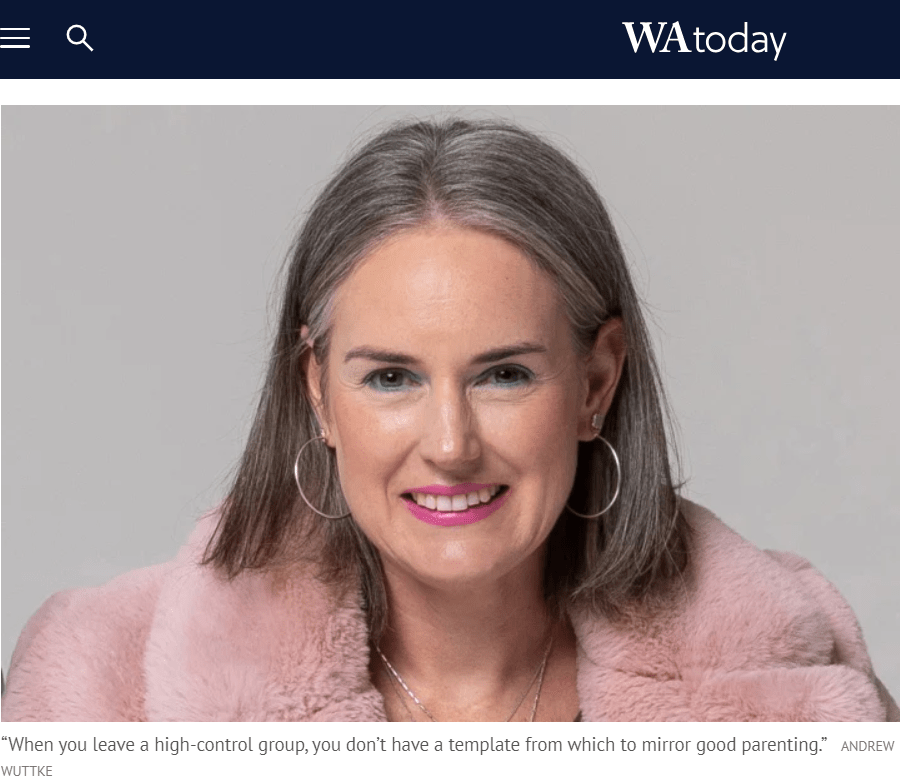
When you leave a high-control group, you don’t have a template from which to mirror good parenting. You’re relearning to do things in a very different way and, as a result, I find parenting to be a lonely experience.
And due to the abuses I experienced, I’m hyper-vigilant. This means my son hears and learns about personal safety and consent at a much younger age than most. In turn, during periods when I’m not feeling well, he understands that I can’t be completely present in his life.
I aim to raise a well-rounded human being, who can identify safe people, has the ability to be confident in life and is surrounded by good friends, so he won’t need to fill his voids from such groups.”
“The backlash from the parish was shocking” Mel Welch, 41, was born and raised under strict religious doctrine. When she left the church, she was overprotective of her children. She has since learnt that instilling self-trust is the best way to empower them.
“There were lots of rules and heavy control under the religious group I was raised in. The biggest fear instilled in me was of going to hell. It was deeply ingrained that if I upset anyone or did anything wrong, that would upset God and I would be banished to hell automatically. So I made sure not to upset the pastors or my parents.
I married a pastor’s son when I was 18 and he was 20. Marriage was the only way that being alone together would be allowed by the pastors.
Sadly, my first-born child died at birth. The backlash from the members of the parish was shocking: some said my baby’s death was because we didn’t pray enough. We were consequently given six weeks to get over our grief.
I went on to have four more children and by the time I turned 30, I could no longer keep up with the pressure I was putting on myself to attend weekly church gatherings and Sunday service. Feeling that no matter what I did I would never be enough, one Sunday afternoon in 2012 I sat opposite my husband and said, ‘I’m no longer attending church.’ My body felt nauseous from the anxiety of even hearing me say that and my husband turned white. That goes to show just how much power they had over our lives.
Consequently, I was shunned by the community. Gradually, my husband came to his own realisation and conclusion about the church and followed me six months later.
During this time, I continued to read the Bible on my own. The more I did, the more I started to listen to and trust my intuition about what the teachings meant. This is a new God, I realised. I slowly understood that I wasn’t going to die because I’d left the church. It was all a lie, so I started to wonder what else wasn’t true.
There was definitely a long transition period around figuring out how to raise my kids, because I was relearning so much and essentially becoming an adult myself. Until I was able to discern the lies from the truths, I became overprotective of them, a form of helicopter parenting, especially around any sort of religious ideas or strict ideals.
Over time, I realised that self-trust is necessary to thrive. I’ve taught my children to create a personal relationship with God through reading the Bible on their own, a relationship that’s based on self-awareness and confidence in their own instincts.”
“Marrying outside the church was frowned upon” Susannah Birch, 37, was raised in a church that discouraged her from engaging in “worldly” activities. She is teaching her children how to be independent thinkers.
“One of the main teachings I was raised on is that Christians shouldn’t be ‘worldly’. This meant I wasn’t allowed to read mainstream books – by the time I was 12, I had actually read the Bible twice – watch popular movies or wear ostentatious jewellery or make-up. Sex before marriage was considered a sin. Further, being friends with or marrying anyone from outside the church group was severely frowned upon because they were considered to be ‘evil’.
My parents divorced when I was 13, by which time my family had distanced itself from the church. To my surprise, my father, who maintained more balanced religious beliefs, allowed me to do things considered worldly. I quickly discovered the Spice Girls and Buffy the Vampire Slayer, and that began to change my whole world view. I also read different book genres and that made me question everything I had been taught growing up.
Subsequently, at age 20, I married a non-Christian. And when I had my two children, I intentionally introduced them early on to a wide range of fiction, music and movies so they could have a holistic view of the world.
Prior to becoming a parent, I thought I was over my indoctrination. Yet whenever my children did things the church would consider wrong or ‘sinful’, I was back in that world. I had to take conscious steps to prevent myself from imposing narrow ideas on my children. Today, whenever my children do something wrong, I try to explain to them why it’s wrong, as opposed to the punishments I received growing up, which I was never allowed to question.
My children attend a Catholic school, which I chose due to the quality of education it offers. It doesn’t bother me that they may be exposed to religious teachings, because at home we read and talk about multiple religions and philosophies, including paganism and Buddhism.
I’ve done my best to teach them to see different points of view and choose what they want to follow, after applying critical thinking. If they feel that something is true simply from emotions or peer pressure, I try to encourage them to question why and to think for themselves, not to be swayed by others’ opinions. I also want them to question the world around them and not to sit in self-criticism, as the church I grew up in taught me to do.”