Stepmothers don’t have the best reputation — thanks in no small part to our wicked fairytale counterparts.
And when it comes to being a stepmum, there are no clear rules, very little advice and few good role models.
As a chartered psychologist, I became fascinated by stepfamily dynamics when I moved in with my now-husband, happily hoping to form a family with my two young children and his little boy.
I confess I was shocked to find my new role to be far more difficult than I imagined.
This inspired me to conduct research into the dynamics of blended families and to write a book, How To Be A Happy Stepmum, in a bid to share my observations and findings with other women in my position.
With nearly a third of British households now including stepchildren, we stepmums need all the advice and support we can get!
One concern that frequently crops up is navigating the tricky issue of bonding with your partner’s children.
Get that dynamic wrong and you could be in for a world of pain.
Follow my expert advice, however, and you’ll open the door to wonderfully fulfilling relationships with your partner’s children that will stand the test of time.
TAKING THINGS SLOWLY
Research shows it can take four to seven years for everyone to find their happy place in a blended family — and the children will usually be the last to come around.
You and your partner might have been absolutely sure of your decision to be together from the start, but children will often struggle to understand the feelings between you.
They might be grieving the perceived loss of their previous life or resent the new woman taking their beloved mother’s place. If you go rushing in expecting their full support from the off, you might be waiting a long time.
DON’T EXPECT TO LOVE THEM
It is a common myth that you will automatically love your stepchildren. It’s uncomfortable to admit, but sadly this isn’t the reality.
And don’t expect them to love you, either.
In fact, the best you can hope for is that they like you. Count those little marks of respect and appreciation (“hello” and “thank you”) as a small win.
As you build trust, feelings of mutual love will grow.
DON’T TRY TO BE A ‘SUPER STEP MUM’
If you go overboard with gifts, attention or Stepford Wife-style baking marathons, your efforts are unlikely to be rewarded.
Children expect adults to look after them and rarely show the gratitude step-parents expect.
This can be incredibly demoralising for you, and if you lose heart and stop making any effort at all the children can become very confused by your flip-flopping attentions.
Instead, dial down your efforts and your aspirations.
If the stepchildren are younger, think of yourself as an aunt or godmother figure. If they’re older and you don’t have any parenting experience, think of yourself (initially) as a friend to them.
The last thing any teenager wants is another parent, so try saying: “You have a mum and dad and you have me as well, as an extra person who cares about you.”
Find something to share
Aim to spend a little time with each child individually — just the two of you, without your partner. That might mean watching endless episodes of Dr Who together, taking a regular Saturday morning trip to a coffee shop or making a vegetable patch in the garden.
Creating a regular activity that links you with the child allows you both to gently bond and become at ease with each other.
Children will usually defer to their biological parent but if you are the only adult on hand during these sessions they are likely to be nicer to you, and your relationship should improve.
One bedtime for all
If you’re trying to blend your own children with your partner’s children you must sit down and agree on shared rules and boundaries (bedtimes, control of the TV remote, sitting at the table for meals etc).
There’s nothing more likely to breed resentment than the perception that some are being treated more favourably than others.
DON’T CRITICISE THEIR MOTHER
You might feel jealousy towards the children’s mother, resentful if she doesn’t recognise your involvement or even angry at her perceived failings, but keep all negative feelings to yourself (or between you and your partner).
Quizzing the children about their “other life” can create tension that can put any bond under strain.
They need to feel comfortable, not interrogated. Your job is to provide a safe space where you can grow your relationship with your partner and his children.
SPEND TIME APART
It is understandable to want to throw yourself into family life, but stepfamilies can be stressful to navigate. Try to build some time away to reset your batteries and give yourself back a sense of control.
Just being able to pop out to the gym, grab a coffee with a friend, or sit on your own to read or watch TV can help protect you from becoming overwhelmed.
Without a break, stress levels can mount, leading to resentment that could impact your ability to bond.
Being raised under strict religious doctrine can have knock-on effects that impact all parts of life, particularly parenting, says Dr Cathy Kezelman, president of Blue Knot Foundation, an organisation that provides information and support to those suffering complex trauma. “When you’ve been raised within a controlled environment with very little freedom to make your own choices or realise that you can make choices,” she says, “it’s very difficult to develop the strong core sense of self necessary to provide your children with a secure base from which they can explore the world.”
According to Kezelman, healing begins by making sense of what has happened, how it affected you, learning self-compassion and re-evaluating your upbringing through parenting your own children. “Ways to achieve this can include counselling, self-care, meditation, yoga and art therapy. All can help to soothe the nervous system, build a sense of safety and trust and, as a parent, gradually enable your children to develop a sense of security and autonomy.”
Here, three women who have left their religion share their experiences.
“Parenting has been a healing experience” Laura McConnell Conti, 43, was a fifth-generation member of a strict fundamentalist Christian sect. Because she suffers from complex post-traumatic stress disorder, the responsibility of parenting falls on her child’s father.
“From age 12, I helped to raise my siblings. I was the eldest girl and that was what was expected of me because of our religious community’s gendered beliefs. Daily, I had to prepare their clothes, get them ready for school, help them with their homework. On the weekends I had to ensure they attended church events wearing the right dresses and having their hair in the right style. Overall, I had to keep their behaviour in line with our religious beliefs and this left me exhausted.
Wanting something different for my life, I left the church at 19. Once I got an education and a well-paying job, I was able to afford therapy. Subsequently, I spent my late 20s and 30s recovering from complex trauma – a consequence of having to worry about and care for others when I was a child myself.
At first, I didn’t want to have children. I didn’t feel I was maternal like other women seem to be, or that I had the capacity to raise a child without it impacting my health.
Eventually, I met with someone who understood that the only way I could have a child was if he was the primary carer, and I had a son in my late 30s.
I didn’t think my life would change very much, but the reality is that parenting has been a healing experience for my own childhood trauma – although that was not the intention or the expectation.
My parenting style is hands-off. I don’t have the capacity to worry or organise for my son. Difficult things, like going to the doctor or getting vaccinations, I leave to his father. I get to do more of the fun stuff – clothes shopping, hanging out and playing.
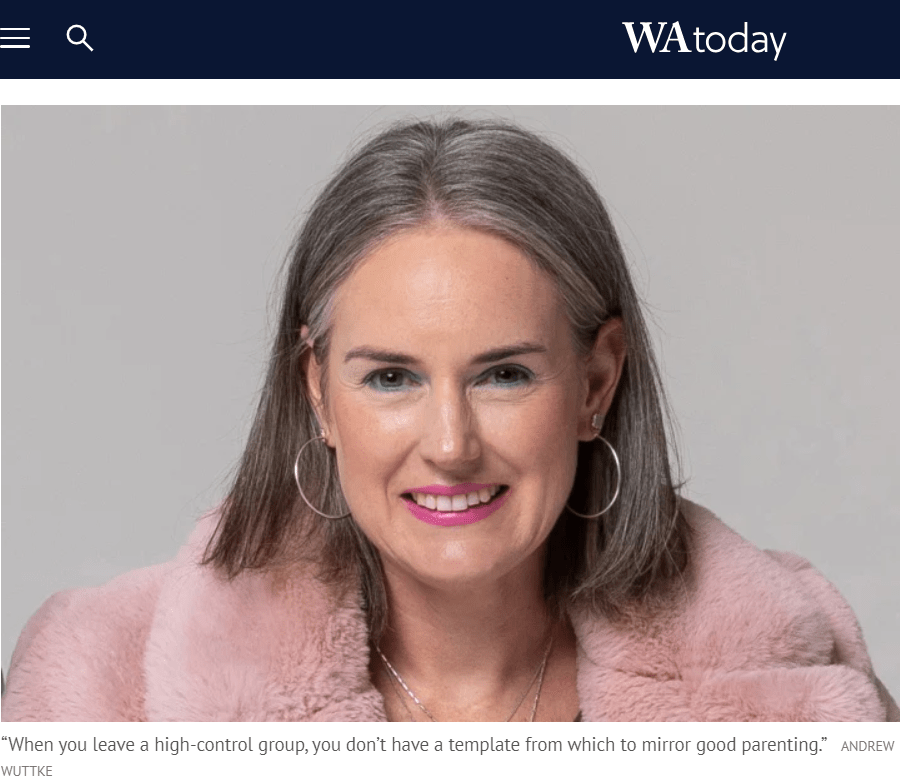
When you leave a high-control group, you don’t have a template from which to mirror good parenting. You’re relearning to do things in a very different way and, as a result, I find parenting to be a lonely experience.
And due to the abuses I experienced, I’m hyper-vigilant. This means my son hears and learns about personal safety and consent at a much younger age than most. In turn, during periods when I’m not feeling well, he understands that I can’t be completely present in his life.
I aim to raise a well-rounded human being, who can identify safe people, has the ability to be confident in life and is surrounded by good friends, so he won’t need to fill his voids from such groups.”
“The backlash from the parish was shocking” Mel Welch, 41, was born and raised under strict religious doctrine. When she left the church, she was overprotective of her children. She has since learnt that instilling self-trust is the best way to empower them.
“There were lots of rules and heavy control under the religious group I was raised in. The biggest fear instilled in me was of going to hell. It was deeply ingrained that if I upset anyone or did anything wrong, that would upset God and I would be banished to hell automatically. So I made sure not to upset the pastors or my parents.
I married a pastor’s son when I was 18 and he was 20. Marriage was the only way that being alone together would be allowed by the pastors.
Sadly, my first-born child died at birth. The backlash from the members of the parish was shocking: some said my baby’s death was because we didn’t pray enough. We were consequently given six weeks to get over our grief.
I went on to have four more children and by the time I turned 30, I could no longer keep up with the pressure I was putting on myself to attend weekly church gatherings and Sunday service. Feeling that no matter what I did I would never be enough, one Sunday afternoon in 2012 I sat opposite my husband and said, ‘I’m no longer attending church.’ My body felt nauseous from the anxiety of even hearing me say that and my husband turned white. That goes to show just how much power they had over our lives.
Consequently, I was shunned by the community. Gradually, my husband came to his own realisation and conclusion about the church and followed me six months later.
During this time, I continued to read the Bible on my own. The more I did, the more I started to listen to and trust my intuition about what the teachings meant. This is a new God, I realised. I slowly understood that I wasn’t going to die because I’d left the church. It was all a lie, so I started to wonder what else wasn’t true.
There was definitely a long transition period around figuring out how to raise my kids, because I was relearning so much and essentially becoming an adult myself. Until I was able to discern the lies from the truths, I became overprotective of them, a form of helicopter parenting, especially around any sort of religious ideas or strict ideals.
Over time, I realised that self-trust is necessary to thrive. I’ve taught my children to create a personal relationship with God through reading the Bible on their own, a relationship that’s based on self-awareness and confidence in their own instincts.”
“Marrying outside the church was frowned upon” Susannah Birch, 37, was raised in a church that discouraged her from engaging in “worldly” activities. She is teaching her children how to be independent thinkers.
“One of the main teachings I was raised on is that Christians shouldn’t be ‘worldly’. This meant I wasn’t allowed to read mainstream books – by the time I was 12, I had actually read the Bible twice – watch popular movies or wear ostentatious jewellery or make-up. Sex before marriage was considered a sin. Further, being friends with or marrying anyone from outside the church group was severely frowned upon because they were considered to be ‘evil’.
My parents divorced when I was 13, by which time my family had distanced itself from the church. To my surprise, my father, who maintained more balanced religious beliefs, allowed me to do things considered worldly. I quickly discovered the Spice Girls and Buffy the Vampire Slayer, and that began to change my whole world view. I also read different book genres and that made me question everything I had been taught growing up.
Subsequently, at age 20, I married a non-Christian. And when I had my two children, I intentionally introduced them early on to a wide range of fiction, music and movies so they could have a holistic view of the world.
Prior to becoming a parent, I thought I was over my indoctrination. Yet whenever my children did things the church would consider wrong or ‘sinful’, I was back in that world. I had to take conscious steps to prevent myself from imposing narrow ideas on my children. Today, whenever my children do something wrong, I try to explain to them why it’s wrong, as opposed to the punishments I received growing up, which I was never allowed to question.
My children attend a Catholic school, which I chose due to the quality of education it offers. It doesn’t bother me that they may be exposed to religious teachings, because at home we read and talk about multiple religions and philosophies, including paganism and Buddhism.
I’ve done my best to teach them to see different points of view and choose what they want to follow, after applying critical thinking. If they feel that something is true simply from emotions or peer pressure, I try to encourage them to question why and to think for themselves, not to be swayed by others’ opinions. I also want them to question the world around them and not to sit in self-criticism, as the church I grew up in taught me to do.”

 陳旭@perth